
Fuel Type: plug-in-hybrid-phev

BYD makes quick progress in the European EV market

As Europe’s electric vehicle (EV) market grows, newer entrants such as BYD are establishing themselves. Autovista24 journalist Tom Hooker examines the latest figures from EV Volumes.

EV sales in Europe have continued to charge forward, with a year-on-year uptick of 27.1% between January and September. According to EV Volumes, a combined total of 2,720,459 battery-electric vehicles (BEVs) and plug-in hybrids (PHEVs) were sold.

This growth was spearheaded by a 34% improvement in the third quarter, as 926,519 new EVs were delivered.

So far this year, PHEVs have recorded greater growth rates than BEVs. EV Volumes does include extended-range electric vehicles in its plug-in hybrid figures. PHEVs enjoyed a 31.5% rise in demand during the first nine months of 2025, with 919,112 deliveries. This is an improvement from the 21.7% growth in the first half of the year.

Monthly PHEV volumes have ramped up throughout 2025, peaking with a 55.7% increase in September, reaching 130,179 sales. This marked the powertrain’s best year-on-year growth since June 2021, and its highest monthly figure since December 2022.

This means PHEV’s share of the EV market increased to a 33.8% slice between January and September. This was a 1.1 percentage point (pp) rise from its position during the same period of 2024.

BEVs saw greater volumes across the first three quarters of the year. A total of 1,801,347 all-electric models took to European roads from January to September. This was an improvement of 25% year on year.

The technology saw 257,297 deliveries in September alone, capping a ninth consecutive month of double-digit growth. This was its highest monthly total since December 2022 and marked a 20.3% increase compared to one year prior.

So, with growth in almost every month so far this year for both powertrains, which brands have capitalised, and which have fallen behind?

Chinese brands increase EV share

Chinese brands have undoubtedly increased their EV presence in Europe. Many carmakers from the country have seen their market shares rise this year, as volumes have surged.

One example is BYD, which recorded a 302.6% year-on-year EV sales improvement over the first three quarters of 2025. This means out of the top 10 best-selling EV brands in Europe this year, it is comfortably the fastest-growing.

BYD was eighth in the EV sellers ranking between January and September. The carmaker’s 119,085-unit total translated to a 4.4% market share, up 3pp compared to the first three quarters of 2024.

Between July and September, the Chinese brand’s volumes rose by 284% to 48,336 registrations. This placed it seventh in the quarterly table, with a 4.8% market hold, up from 1.8% during the third quarter of 2024.

Seal U steals the show

The highlight of BYD’s EV range was the Seal U plug-in hybrid. It led Europe’s year-to-date PHEV market for the first time in September, moving past the VW Tiguan with 45,837 units. This also marked the first time a model from a Chinese brand has led Europe’s cumulative PHEV or BEV standings.

This was thanks to a 10,089-registration tally in September alone. This made it the month’s third-best-selling EV in Europe, behind only the Tesla Model Y and Tesla Model 3.

Xpeng has also made significant progress in Europe this year. The brand’s volumes soared by 185.3% to 12,729 units after nine months of 2025. Its G6 SUV has been its best performer, with 8,751 so far this year.

Meanwhile, Lynk & Co saw a 20.8% increase in deliveries from January to September, with 6,351 registrations. The majority of the carmaker’s volume came courtesy of its 01 PHEV.

Barriers to entry remain

The entrance of new brands does not come without hurdles, however. BEVs produced in China still face steep EU import tariffs, which were imposed in October 2024. This means increasing their European EV presence is not easy. Carmakers may consider localising production or raising list prices.

Some brands are focusing on plug-in hybrids. While PHEVs are subject to the regular 10% EU import duty, the technology does navigate around the BEV tariff rate.

For example, PHEVs made up 85.1% of Lynk & Co’s EV sales. Conversely, Xpeng focused solely on BEVs, which represented 100% of its EV deliveries. BYD had a more balanced strategy, with PHEVs accounting for 40.1% of its EV total.

VW doubles down on EVs

Volkswagen (VW) continued to sell the greatest volume of EVs in Europe after the first nine months of 2025. The brand’s total of 305,746 deliveries equated to a 104.6% surge. In turn, VW’s market EV share rose by 4.2pp to 11.2%.

The German marque’s pace is not slowing down. It recorded the most EV registrations in Europe from July to September, with 101,683 units equating to an 84.8% year-on-year improvement.

The brand has seen many of its EV models perform well this year. In the BEV market, the VW ID.3 sat fourth after the first three quarters of 2025, with 57,699 units. The ID.4 took seventh, followed by the ID.7 in eighth, with 56,186 and 53,570 registrations, respectively.

For nine months in 2025, the VW Tiguan has been in a hotly contested battle at the top of the PHEV market. It sat in second with 45,277 deliveries, putting it just 560 units behind the BYD Seal U.

BMW’s comfortable position

BMW’s EV sales recorded a 15.6% improvement from January to September, posting 245,276 deliveries. It was secure in second position at the end of September. The brand trailed VW by 60,470 units, while sitting ahead of third by 60,046 deliveries.

The manufacturer captured 9% of the European EV market. However, due to increased competition, this was a 0.9pp drop compared to the first three quarters of 2024. In the third quarter alone, its share fell by 1.3pp to 8.7%. This was despite a 17% rise in volumes to 80,809 units, which placed it in second.

However, the brand only placed one model in the cumulative top 10 of both the BEV and PHEV rankings. The BMW iX1 was the 10th best-selling BEV in Europe, with 46,775 deliveries, 3,446 units behind ninth. Meanwhile, the BMW X1 landed fifth in the PHEV standings, posting 30,314 deliveries from January to September.

Stagnation for Mercedes-Benz?

Mercedes-Benz was the third German brand to make Europe’s EV top three. This was thanks to 185,230 sales across the first three quarters of the year.

However, this was down 0.6% compared with the same period of 2024, mainly caused by a poor first quarter. Consequently, its share in the first nine months of 2025 dropped from 8.7% to 6.8%.

Yet, Mercedes-Benz managed a 5.4% increase in registrations between July and September, with 63,412 units. Should Mercedes-Benz be able to replicate this result in the last three months of the year, it could avoid a full-year decline.

Just one of its models sits in the BEV or PHEV top 10, namely the Mercedes-Benz GLC plug-in hybrid. The SUV is in seventh in the year-to-date BEV standings with 25,847 units. It was closely followed by the MG eHS, just one delivery behind in eighth.

Tesla banks on Model Y

Tesla deliveries took a 29.2% drop in Europe between January and September, equating to a loss of 71,131 units. Meanwhile, its share slumped by 5.1pp to 6.3%. Yet, the brand still took fourth in the year-to-date table, with 172,582 units.

Tesla’s decline was less pronounced in the third quarter, with a 20.4% drop, to 62,557 registrations.

The Model Y and the Model 3 made up 99.3% of Tesla’s sales in Europe after three quarters of 2025. The crossover comfortably led Europe’s all-electric market after nine months of the year, with 109,524 units.

Meanwhile, the Model 3 moved up to second in September. It sat 47,738 deliveries behind its sibling, recording 61,786 registrations from January to September. Both models also locked out the top two spots in the month’s BEV table, despite their volumes falling year on year.

Audi’s growing EV presence

Audi moved up to fifth in Europe’s year-to-date EV standings, thanks to 151,005 deliveries. This represented year-on-year growth of 14.2%. However, its share fell by 0.6pp to 5.6%. In the third quarter alone, the German marque enjoyed a 33.4% uptick in demand to 51,034 units, placing it in sixth.

No Audi models featured in the BEV or PHEV top 10 tables after nine months of the year. However, the Q6 e-tron did place 10th in September’s monthly all-electric standings, with a 253.9% delivery surge to 5,323 units.

Yet, it was the Audi Q4 e-tron that was the brand’s most popular EV model after three quarters of 2025. It represented 29.3% of the carmaker’s overall plug-in figure.

Falling EV registrations for Volvo

Volvo suffered a 17.3% fall in EV sales from January to September, dropping to sixth in the year-to-date table. Its 147,339-unit total gave it a 5.4% share of the market, down from 8.3%.

The manufacturer endured an even steeper decline of 17.8% in the third quarter alone, with volumes dropping to 44,849 units. Its market hold in this period was 4.4% down from 7.9% in the third quarter of 2024.

Its Volvo XC60 sat in third in the year-to-date PHEV table with 42,555 units, just behind the VW Tiguan. The model landed fourth in September’s monthly standings, pipped by the Jaecoo J7. The SUV made its first-ever appearance in the PHEV top 10, with a record 6,122 registrations.

Skoda’s mixed EV performance

Skoda posted a 129.3% surge in plug-in deliveries during the first nine months of 2025. It sat seventh in the cumulative table with 145,385 units, as its share grew by 2.3pp to 5.3%.

This improvement was foreshadowed in the third quarter. The brand saw a 95.7% rise in volumes between July and September alone, putting it fifth. Two BEVs have led Skoda’s EV efforts, although they faced contrasting fortunes.

The Elroq moved up to third in the year-to-date BEV table, with 58,680 registrations, just 3,106 units behind second. It also took third in September’s monthly BEV standings, with 9,972 deliveries.

Its older sibling, the Enyaq, fell two spots to sixth in the cumulative BEV chart, with 56,581 units delivered.

Cupra and Renault fall

BYD’s improvement came at the expense of Cupra and Renault, who were victims of the continent’s competitive nature. The brands dropped to ninth and 10th, respectively, in Europe’s EV standings after the first three quarters of the year.

This was despite a volume increase of 80.4% for the former, as its share grew from 2.9% to 4.2%. Meanwhile, Renault’s EV registrations surged by 82.8%, equating to a 1.3pp rise in share to 4.1%. Yet, neither brand featured in the third quarter’s EV top 10.

The combined total of the Renault 5 and Alpine A290 represented over half of Renault’s EV total between January and September. The hatchback sat fifth in the BEV chart after three quarters of 2025, with 56,642 deliveries.

Cupra’s most notable model was the Formentor, which secured ninth in the PHEV top 10 after three quarters of the year. This was thanks to 21,480 deliveries.
Is China’s new PHEV struggle affecting brands’ EV sales?

China’s plug-in hybrid (PHEV) market appears to be slowing following another month of struggling growth. But how are these performances affecting domestic brands? Autovista24 special content editor Phil Curry examines the data.

In September, China’s PHEV market, including range-extended electric vehicles, once again showed signs of a slowdown. Its 0.4% year-on-year improvement was the lowest result since a 51.4% decline in June 2020, according to EV Volumes data. Meanwhile, the BEV market grew once again in September. In total, 836,711 models were sold, which equated to a rise of 26.5%.

Between January and September, China’s PHEV market saw 3,859,629 passenger car sales, a 21% increase year on year. At the end of the first half of 2025, this growth was at 35.7%, highlighting the powertrain’s third-quarter struggles.

Meanwhile, the BEV market saw an improvement of 37.4% across the first nine months of 2025.

The overall Chinese electric vehicle (EV) market rose by 30.3% over the first three quarters of the year. However, this was down by 10.1 percentage points (pp) compared to the growth in the first half of 2025.

The PHEV problem

Some of the most popular PHEV models in China suffered declines in the third quarter. Combine this with the growth recorded at the end of 2024, and the last quarter of 2025 may prove difficult.

The market’s issues have caused problems for some Chinese brands, especially those with a stronger PHEV offering. Both Li Auto and Aito have posted overall declines after three quarters of the year.

BYD, which dominates the PHEV market, saw its numbers fall between July and September, coinciding with the PHEV slowdown. For the second consecutive month, the BYD Song Plus did not make the monthly top 10, hampering its sales growth.

The PHEV sector could play a crucial role in determining how certain brands perform for the rest of the year. Meanwhile, a strong BEV market is helping some domestic marques go from strength to strength.

BYD’s third-quarter PHEV struggles

Nine months into 2025, BYD sold the largest volume of EVs of any brand in China. But its growth slowed dramatically in the third quarter. With 52.6% of its sales coming from PHEVs, is it responsible for the sector’s poor form in the same three-month period?

Between July and September, the carmaker saw volumes drop by 19.4%. This meant its figures for the nine-month period grew by just 2.5%. In the first half of 2025, the brand’s numbers were up by 19.9%

With a 24.9% EV market share in the first three quarters of 2025, it is comfortably the region’s plug-in leader. However, its hold has slipped by 6.8pp compared with the same period last year.

It is the PHEV market where BYD has struggled the most. Six of BYD’s PHEVs made the top 10 in September this year. Of these, four models lost volume year on year, while the Qin Plus recorded an improvement of 41%. Meanwhile, the BYD Sea Lion 06 first recorded sales in June this year.

But the brand’s problems are not just related to plug-in hybrids. In the BEV market, the BYD Seagull placed fifth in September as its sales shrank by 47.3% year on year.

However, this was countered by the BYD Yuan Up in fifth, which enjoyed a 61.8% improvement. Furthermore, the BYD Dolphin saw a 41.7% uptick in demand in eighth.

The carmaker is focusing on export markets, while it maintains a diverse portfolio of products in its domestic market. For now, BYD can rest on its laurels, with no real challenger yet in sight.

Geely’s standout performance

The standout brand so far this year has been Geely, including its Galaxy subsidiary. The carmaker has seen volumes increase by 234.7% in the first nine months of 2025. This equated to an 8.8% market share, up 5.4pp.

Geely took a stronger footing in the BEV market, with 69.5% of its EV sales coming from all-electric models. This was thanks to the Geely Geome Xingyuan, which was the best-selling BEV in China between January and September. It made up 59.1% of Geely’s BEV deliveries in the period, and 41.1% of its total sales in the nine months.

But Geely has endured PHEV struggles too. The Galaxy Starship 7, which led the market in January, has since slipped down the charts. The model did not place in the top 10 during September and sat in 10th in the cumulative results after nine months.

Yet the new Galaxy A7 may offer some hope. It made its way into the top 10 for the first time in August and placed again in September. Still, Geely’s performance after three quarters owes much to the Geome Xingyuan, which is likely to be China’s best-selling BEV at the end of 2025.

Wuling and Tesla’s rollercoaster ride

Wuling, incorporating its Baojung subsidiary, has seen inconsistent results so far this year. Yet after three quarters of 2025, the carmaker still saw volumes improve by 44.1%. Its market share sat at 5.9%, up by 0.5pp.

Like Geely, Wuling’s volumes came mostly from the BEV market. Of its EV sales, 94.1% were all-electric. The Wuling Mini was China’s third-best-selling BEV between January and September.

It was helped by its chart-topping performance in September, beating the Tesla Model Y by 570 units. This was an impressive result, considering the US brand’s quarterly push, which often sees it lead in the month.

Tesla was the fourth best-selling brand after three quarters of the year. The brand saw its volumes fall by 6.1% year on year between January and September 2025. Meanwhile, market share dropped by 1.8pp.

With a 100% focus on the BEV market, Tesla is not affected by the fluctuation in the PHEV sector. Its Model Y has performed well, but it is not leading the market as it has in the past.

Additionally, the Model 3 has seen its popularity decline. In September, its deliveries fell by 15.2% year on year, despite the brand’s end-of-quarter push.

Leapmotor leaps forward

Between January and September, Leapmotor took fifth in the brand table for EV sales, following a strong third quarter. It jumped domestic rival Chery, which took fifth in the first half. Leapmotor’s success was largely thanks to its BEVs. These models accounted for 78.6% of its EV sales, meanwhile Chery’s all-electric cars only accounted for 29.5%.

These results are more impressive considering neither brand was present in the BEV or PHEV cumulative model tables. It seems each has a higher volume of models that are popular further down the table.

In total, Leapmotor’s sales were up 116% between January and September, with a 3.8% market share. This was up by 1.5pp year on year. Chery, meanwhile, saw growth of 126.6%, with a 3.8% hold of the EV market too. This was up 1.4pp compared to the same period in 2024.

Seventh in the brands table went to Li Auto. The carmaker also struggled, with volumes down 12.3% year on year. With 92.2% of its sales coming from PHEVs, it appears the marque has been affected by the powertrain’s slowdown.

Xpeng was next, with volumes rising by 213.6% over the first three quarters. This gave the brand a 3% market share, jumping by 1.8pp. Aito was another to struggle, with a 3.6% decline in volumes. The carmaker is another with a majority of its sales coming from PHEVs. This may have led to its overall share falling by 1.1pp, to 2.9%.

Xiaomi saw the biggest gain of all carmakers in the top 10 after nine months of 2025. The BEV-focused marque saw volumes grow 281.8%, with its market share up 1.8pp, reaching 2.8%.

September surprise

China’s BEV market saw a surprising result in September. The Wuling Mini led the way thanks to 51,743 sales, a jump of 78.9% year on year. It led the Tesla Model Y, which saw 51,173 deliveries.

The US brand usually leads the end-of-quarter months thanks to its reporting style. The Model Y was able to achieve a 6.2% volume increase. However, this was not enough to top the BEV chart across January to September, symbolising its ongoing struggles.

Meanwhile, the Geely Geome Xingyuan placed third in the month. The model saw its first sales take place in the same month of 2024, albeit in small amounts. It achieved a 5.7% share of total BEV sales in September.

In the first nine months of 2025, the Geome Xingyuan continued to lead. It was 50,671 units ahead of the Tesla Model Y in second, having lost a little ground in the month. The Wuling Mini closed on the US crossover, trailing by just 5,851 units after nine months.

PHEV strength despite struggles

Despite the PHEV market’s struggles, the top two models performed well. Leading the pack in September was the BYD Qin Plus, with 28,201 sales. This was a 41% increase compared to the same month in 2024.

Following this was the Aito M8. In its sixth month on the market, it achieved 21,000 deliveries, giving it a 4.2% market share. Just 229 units behind in third was the BYD Destroyer 05. It achieved 19,771 sales, although this was a 1.7% year-on-year decline. It still held 4% of the market, a 0.1pp drop.

The results meant the BYD Qin Plus extended its lead at the top of the cumulative PHEV chart. However, a strong performance from the BYD Seal 6 in September saw it overtake the struggling BYD Song Plus to sit second. The latter model did not place in September’s PHEV top 10.

How are the latest EV battery developments impacting automotive fleets?

From repair to solid-state advancements, electric vehicle (EV) batteries are a complex equation for fleets. How can these businesses better understand and work with the technology? Autovista24 journalist Tom Hooker assesses the latest battery advancements.

The battery-electric vehicle (BEV) share has grown across Europe this year. In major new-car markets such as France, the fleet sector is a driving force behind electric registrations. Fleet-oriented incentives have helped encourage uptake, as in Germany.

This shift makes it vital for those in the sector to understand the batteries powering their vehicles. In turn, they can make smarter purchasing decisions, optimise maintenance and retain the highest profit margins when defleeting.

Cloud-based battery management

Digital battery health certificates and data can provide clarity for both private consumers and fleets. It can also help increase transparency, streamline remarketing and maximise residual values.

From February 2027, EV batteries sold in the EU must have a Battery Passport. The digital identity will be similar to a vehicle logbook, where battery charge cycles, energy efficiency and degradation trends must be included.

How can fleets stay informed until then? One solution is a cloud-based battery management solution that supports the resale of EVs.

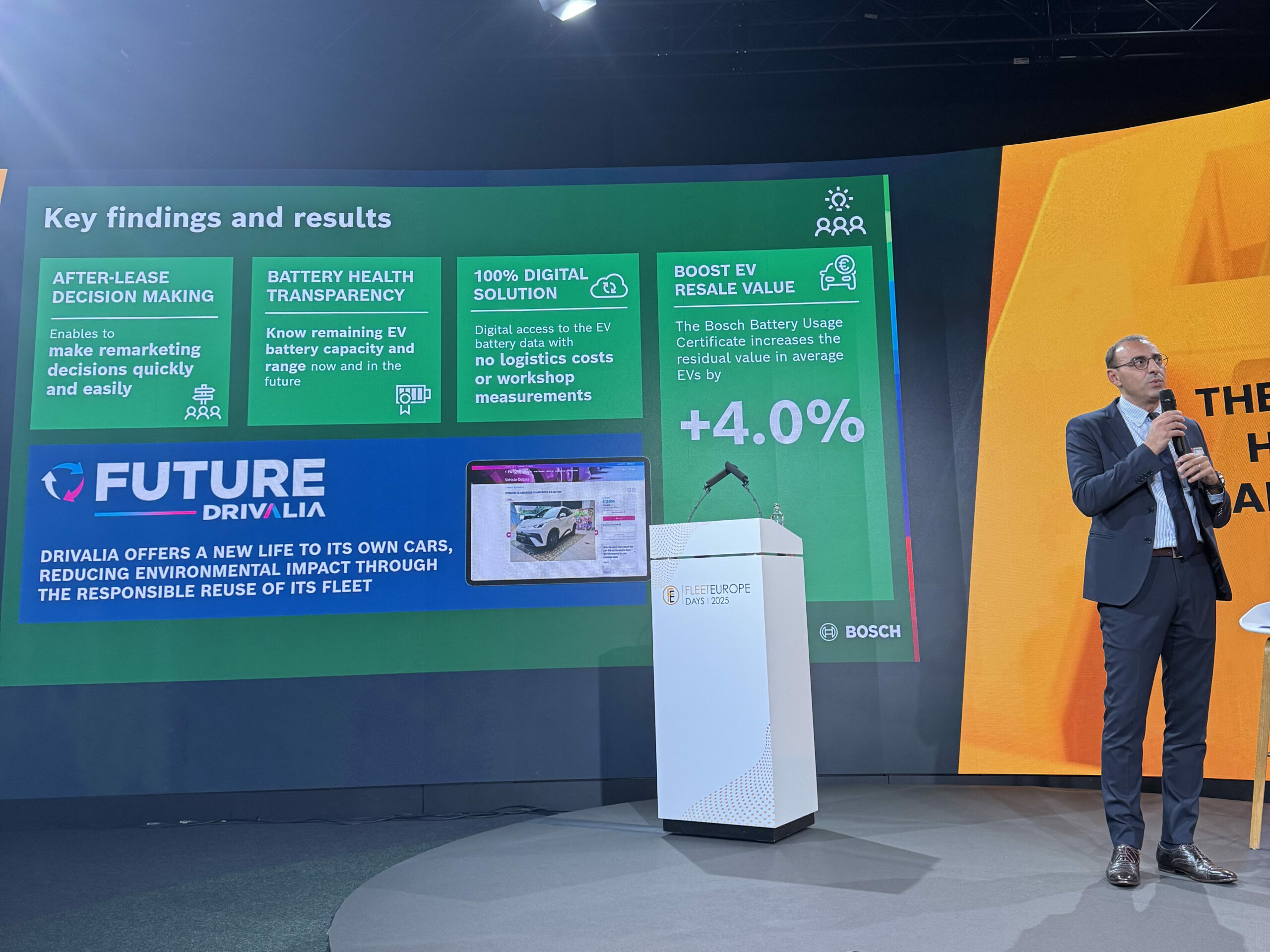
‘Together as leaders in mobility and technology, we have the unique opportunity, especially for EVs, to use remarketing and the right point of resell to make not only a transaction out of it but make it a data-driven business model,’ outlined Christiane Soppa, director of business development at Bosch, at Fleet Europe Days.

Bosch conducted a pilot programme together with European mobility and car rental company Drivalia. This involved monitoring the data of approximately 100 vehicles between January and June 2025.

‘The heart of an EV is the battery. So, we took the heartbeat of the EV and put it online. The target was to take away the EV friction we have in remarketing. We looked at stress factors and anomalies based on very simple data,’ explained Soppa.

Roberto Sportiello presenting at the Fleet Europe Days 2025.
Drivalia CEO Roberto Sportiello.

From transaction to database

There are three steps to the process. Once the EV is connected, data can be collected. Bosch was able to track battery temperature, voltage, charging behaviour and driver usage. This provided a real-time picture of the power-storage unit.

Second, a cell-by-cell digital twin of the battery was created in the cloud. This combined AI machine learning with data taken from 150,000 vehicles tracked by Bosch worldwide to regularly review its algorithm. Third, the system detected anomalies and any battery issues.

‘The twin can completely monitor the battery. By spotting issues very early, you can redesign the right point of resell. We take the battery measurements, the state of health and anomalies before the decision point when you sell the car, not afterwards,’ she stated.

‘That is turning remarketing from a transaction to a database strategy. As a fleet manager or a leasing company, this is changing everything, because you suddenly get into the driver’s seat,’ Soppa continued.

Bosch was also able to produce a certificate at any time, revealing driving behaviour, anomalies, and charging history.

‘You could even use this data to discuss with your clients early, to change their behaviour. Decision making is not a best guess or dependent on lifetime and mileage anymore. It is based on data. What we see from all the pilots we did in the past years, in Bosch and all the data we have, sales can be boosted by up to 4% on average for resale,’ she commented.

However, Soppa highlighted that this requires monitoring of the battery to optimise the point of resale.

‘This is a very important digital platform that will permit the company more in the future to retrieve and collect data from the fleet, and let the company adjust it as best as possible,’ highlighted Drivalia CEO Roberto Sportiello.

Is battery repair the solution?

While Bosch’s tool can be used to boost resales, another way to maximise profit margins within a fleet is to reduce maintenance costs. So, what options do fleet managers have in this instance?

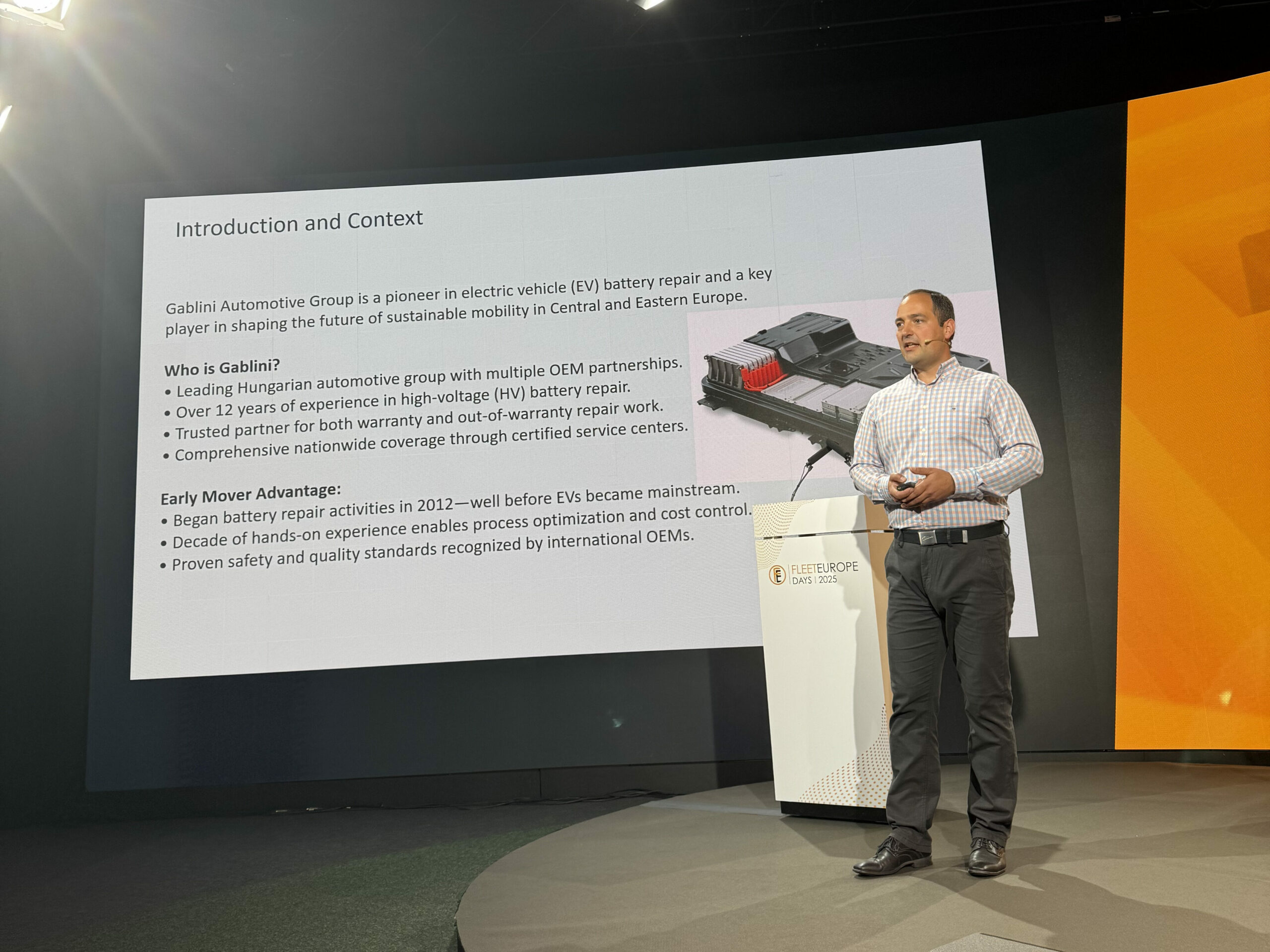
According to Gablini Automotive Group, the cost of repairing a battery pack is around 80% lower than replacing it. This makes battery repair more financially attractive while supporting circular economy goals.

‘To be sustainable, we cannot throw away a 10-year-old vehicle. We should keep it on the road. Because, if we throw it away, the environmentally friendly behaviour of EVs will not be there anymore,’ stated Daniel Pataki, general manager of Gablini Automotive Group, at Fleet Europe Days.

Daniel Pataki presenting at Fleet Europe Days 2025.
Gablini Automotive Group general manager Daniel Pataki.

‘The question is if we can repair the battery packs in case of any failure, because OEMs are not interested in selling battery packs. They are interested in selling new vehicles,’ he said.

Pataki explained how demand for battery repair is growing. As old EVs are getting cheaper, people are beginning to use them as an entrance point to the EV sector. However, he highlighted that an EV with a faulty battery has a resale value of close to zero.

Repair constraints

Pataki presented a diagram of a dismantled EV battery pack. He explained that if one cell has a lower voltage than the rest, this affects the entire battery’s performance. By replacing the module containing that cell, the EVs’ range will improve. The battery management system and thermal management system can also be replaced.

‘If one sensor gets broken in a battery pack and you cannot repair it via the OEM, you should replace the battery pack due to the fault of a €10 sensor. This is not sustainable. You should be able to repair this,’ said Pataki.

However, he explained that there are some constraints. There are still no standard criteria for technicians looking to repair high-voltage batteries. Pataki said that OEMs do invite technicians to their headquarters to get a certificate.

‘According to our experience of more than 12 years, 85% of faulty battery packs were economically repairable. That means only 15% of the battery packs coming to us needed to be replaced,’ he noted.

Pataki pointed out that buying parts from the OEM will mean reduced margins compared with individual battery repair. For a 14-hour job, a profit margin of around 40% to 60% can be achieved Pataki calculated. He highlighted that the solution opens up profit potential within the after-sales process.

‘You will provide sustainability. You will gain customer satisfaction because all customers will come back to you for battery repair. We can reduce waste, we can extend the lifespan of vehicles, we can have high-margin jobs in the workshop, and we can make the customer happy,’ outlined Pataki.

Battery market domination

So, the fleet sector needs to be aware of current battery developments, such as real-time data analysis and battery repair. However, it is equally important to know what to expect in the future.

Currently, the EV market is dominated by lithium iron phosphate (LFP) and nickel manganese cobalt (NMC) batteries. From January to August 2025, these two chemistries accounted for over 90% of the megawatt-hours installed across the global passenger car market, according to EV volumes data. However, the market’s composition could change over the next few years.

Mix and match approach

‘What we see is quite a detailed chemistry layout. In the US, you have the nickel cobalt aluminium (NCA) component that is mainly used by Tesla. While in Europe, you have NMC batteries. In China, you have the majority of vehicles or batteries that are LFP batteries,’ said Octavian Chelu, advisory director at Frost&Sullivan at Fleet Europe Days.

‘You might think the picture is quite clear. The US, Europe and China use a certain technology. It is not that easy. When we look towards the future, what we see happening mainly is the fact that carmakers are going to match certain batteries, technologies and chemistries depending on the type of vehicle and its use, he added.’

‘Carmakers are going to try to mix and match from now on. This is something that is going to be keeping revenue from the remarketing business because it needs to juggle very well between different types of technologies, different battery markers, the degradation of those batteries and how much the residual value is going to be impacted by all of that,’ Chelu explained.

‘We have NMC and LFP; those are the main two technologies being used today. However, we also see a lot of heavy research and development, encouraged by all major governments worldwide, because they want to break dependencies,’ Chelu highlighted. ‘We are trying to find alternatives, so that our batteries and our vehicles are not going to be dependent on one source,’

The next battery technologies

Chelu explained that sodium-ion batteries are the next technology being tested. In China, the first vehicles using this technology have already been seen. There are also solid-state batteries in development. However, he believes both chemistries will not completely wipe out LFP’s market share.

‘We are still going to be dependent on precious materials for quite a while. There are pluses and minuses with all these new technologies,’ he said.

Chelu estimated that in the future, sodium-ion batteries are likely to be 30% to 50% cheaper than their LFP counterpart. They also perform extremely well in cold temperatures. This means vehicles using the chemistry can have better charging cycles.

However, sodium-ion batteries have a lower energy density than LFP units. So, models using the chemistry instead of LFP on a like-for-like basis will have less range. Yet, this does mean the emerging technology is slightly safer, due to it being less reactive.

Chelu noted the emerging technology could be well-suited to last-mile deliveries, but less so for long-range vehicles.

Meanwhile, solid-state batteries are safer and more stable than LFP ones, with no flammable liquid electrolyte. Chelu also pointed to a higher energy density, enabling longer distances and faster charging. However, the new technology will be much more expensive to begin with.

‘Sodium-ion is the next to come in line, not to replace LFP batteries, but as a new technology. Solid-state batteries are not going to happen before 2028 and probably will be fully commercial by 2030,’ Chelu concluded.

Is there hope for EV markets across the world?

With so many hurdles to overcome, is there still hope for electric vehicle (EV) markets around the world? Neil King, head of forecasting at EV Volumes, outlines what is expected to happen to sales with Autovista24 editor Tom Geggus.

EV Volumes expects global light vehicle sales, made up of passenger cars and light-commercial vehicles (LCVs), to grow by 3.6% in 2025. This exceeds the expected 1.1% increase outlined in the previous update.

The reason for this improved outlook is resilient demand in China and the non-Triad region. This forecast factors in US automotive tariffs. However, these are likely to have a smaller impact, with carmakers taking a more cautious approach with their pricing strategies. Other factors taken into consideration include political instability, conflicts, energy prices, and inflation.

Global EV deliveries, including battery-electric vehicles (BEVs) and plug-in hybrids (PHEVs), are forecast to increase by 24.5% this year. This means 22.1 million units are expected to hit the roads. The new forecast is up from the 19.7% growth expected in the previous update.

The improved outlook comes despite some governments phasing out purchase incentives and tax breaks amid mounting national debt, particularly in Europe.

The global EV share of the light-vehicle market is projected to grow to 24% in 2025 and 26.7% in 2026. In the following years, this is predicted to rise to 42% in 2030, before hitting 64.1% in 2035, and 83% in 2040. However, budget pressures and policy shifts may threaten investment in incentives and charging infrastructure.

European EV barriers

Western and Central Europe’s light vehicle market is currently facing a barrage of barriers to growth. There is uncertainty about changing goods tariffs, conflict in Ukraine, and tensions in the Middle East concerning European light-vehicle sales.

On top of this, there are the ongoing risks of increasing inflation, oil prices, and energy costs. Furthermore, the September 2025 OECD Economic Outlook predicts that GDP in the Euro area will only grow 1.2% in 2025. This is slightly higher than the 1% growth in the previous forecast. However, this rate is projected to retreat to 1% in 2026, down from 1.2% predicted previously.

Due to weaker goods exports to the US and a struggling services sector, LCV demand was affected by trade frictions and tariffs. Passenger vehicle sales quickly followed suit. Political uncertainty and rising debt levels are also curtailing light-vehicle demand.

More positively, the EU proposed tariff reductions in August 2025 to implement the EU-US trade agreement. This would see duties on the automotive sector reduced from 27.5% to 15%. The EU-Mercosur and EU-Mexico free-trade agreements have also strengthened the competitiveness of the region’s automotive industry. The UK has also negotiated a more favourable 10% tariff rate with the US.

A lower EV outlook

Reflecting the barriers the region faces, EV Volumes has lowered its European light-vehicle sales outlook for 2025. Volumes are now expected to decline by 1.1% year-on-year by the end of 2025. This is lower than in the previous forecast, which projected a 0.3% decline.

The 14.8 million units now expected this year are far below the 18 million registered in 2019. EV Volumes does not expect the European market to return to that level within the current forecast horizon, up to 2040. A 1.9% growth in light-vehicle sales in 2026 hinges on a complex interplay of regulatory and economic factors.

Stricter EU CO2 emissions targets are driving EV sales alongside lower prices, discounting, and the launch of new models. Additionally, the EU Commission plans to adopt a binding regulation in 2026 on vehicle recycling. This will require manufacturers to use more recyclable or reusable materials in new cars and vans.

Meeting the lower emissions targets and circularity requirements will necessitate a major increase in EV sales. In turn, this could even trigger a price war, supported by lower lithium costs. Manufacturers may also restrict the supply of internal combustion engine (ICE) vehicles to avoid costly emissions fines.

Schemes and incentives

On a positive note, Italy announced €597 million in funding for a scrappage scheme. Meanwhile, Germany is considering the reintroduction of BEV incentives, although this is uncertain due to the coalition government and prevailing economic conditions.

In July 2025, the Electric Car Grant was launched in the UK. EV subsidies were increased for low-income households in France. Social leasing and a conditional extra financial incentive for electric models were launched at the end of September. Spain has also reactivated subsidies under the MOVES III scheme.

Meanwhile, more affordable BEVs are entering the market, and leading Chinese carmakers are planning further moves in the region.

PHEV registrations have exceeded expectations so far this year. This has been driven by eased CO2 targets, expanded Chinese PHEV offerings, and delayed launches of low-cost BEVs. Additionally, the UK’s ZEV mandate relaxation means hybrids can be sold until 2035, exempting them from the 2030 new-car ICE ban.

As a result, EV sales in Europe are expected to grow 26.7% year-on-year in 2025 to 3.88 million units. This accounts for 26.2% of total light-vehicle sales, up from 20.5% in 2024 and 21.3% in 2023. BEV volumes are forecast to grow 23.8% year-on-year, accounting for 67.1% of the 2025 BEV and PHEV mix. Meanwhile, PHEV sales are expected to increase by 32.8%.

So, what do new model launches, lower prices, and stricter emissions targets mean in the following years? EVs are forecast to reach a 30.6% share of European light-vehicle sales in 2026 and 36.5% in 2027.

The forecast for 2035 and beyond includes some tolerance for timing interpretations of the new-car ICE sales ban. It also allows for exemptions for vehicles that may be deemed unsuitable for full electrification.

Chinese resilience

Automotive demand and economic resilience have remained firm in China. The OECD recently upgraded the country’s 2025 GDP growth outlook to 4.9%. Meanwhile, EV Volumes has upgraded its light-vehicle market forecast for China. A total of 27.7 million sales are now expected by the end of 2025, equating to year-on-year growth of 6.7%.

This year has seen China’s scrappage programme extended beyond the original January 2025 deadline. However, it has now been suspended in several cities. This could disproportionately reduce demand for EVs given their higher bonus levels.

However, the country has recently announced a plan to stabilise growth in the automotive industry. Accordingly, China is targeting sales of approximately 15.5 million new energy vehicles (NEVs) this year. Alongside this, it is aiming for a 48% NEV penetration rate.

The country also pledged to reduce its greenhouse gas emissions at the latest UN General Assembly. By 2035, China will look to reduce its emissions by up to 10% from their peak levels. This marks the nation’s first commitment to absolute emissions cuts.

Chinese OEMs continue to launch new PHEVs and extended-range electric vehicles (EREVs). Meanwhile, BEVs are regaining momentum, bolstered by aggressive discounting initiated by BYD.

As such, BEVs are forecast to account for 60.1% of EV sales in 2025 and about two thirds by 2031. EVs are forecast to represent 51.6% of light-vehicle sales in 2025, rising to 73% in 2030, then 88.3% in 2035, and 95.7% in 2040.

Forecast volumes are based on retail sales, not wholesale. This excludes exports and inventory build-up, which explains differences from the typically higher wholesale-based figures published by other agencies.

Tariffs, bills and incentives

On 26 March, the US government announced 25% vehicle import duties. However, a two-year ‘import adjustment offset’ program has been implemented for manufacturers producing vehicles in the US.

According to J.D. Power, average new car prices in the US are expected to increase by 5% by the end of 2025. This could lead to an 8% drop in sales. However, many manufacturers did initially absorb the extra costs.

The ‘One Big Beautiful Bill’ act was signed into law in July 2025, ending EV tax credits on 30 September. Any resulting pull-forward effect so far in 2025 is expected to be offset by weaker demand in the final quarter.

Funding for Canada’s iZEV programme ran out in January 2025, with BEV uptake falling and no replacement scheme announced. In response to economic and trade pressures, the Canadian federal government also paused the 2026 Electric Vehicle Availability Standard. This mandated that 20% of new light-duty vehicle sales be zero-emission. The government initiated a 60-day review to assess and potentially adjust future targets.

EV Volumes has updated the 2025 light-vehicle sales forecast for Northern America, covering the US and Canada. The region is now expected to record just over 18 million sales, up 1.2% year-on-year. However, the year-on-year growth outlook was adjusted downward for 2026 to 2029.

The EV share is now expected to reach 10.1% in 2025 and rise only modestly to 10.2% in 2026. This is primarily supported by a more affordable Tesla model. EV shares are forecast to climb to 21.4% in 2030, before achieving 39.8% in 2035, and 59.1% in 2040. This is well below the predicted global EV share of over 80% in 2040.

Non-triad markets weather tariffs

Light-vehicle sales in non-Triad markets have weathered the economic impact of US trade tariffs better than expected. Accordingly, EV Volumes increased its 2025 sales growth forecast to 4.8%.

Japan increased the budget for EV subsidies under the Clean Vehicle Energy Subsidy Programme in early 2025. Meanwhile, India cut import duties for premium EVs as part of a new manufacturing programme in June 2025.

Indonesia introduced VAT exemption for low-emission vehicles in January 2025 and a reduced VAT rate. Finally, in response to US tariffs, South Korea launched temporary stimulus measures. This included financing support and higher EV subsidies.

Budget constraints driven by economic concerns may limit future incentive schemes. Several countries have also implemented, or plan to introduce, new tariffs on imported vehicles. This includes a 50% tariff in Mexico and up to 30% duties in Turkey. Indonesia is also looking to end incentives for imported, completely built-up BEVs, starting in 2026.

Against this backdrop, the EV share in non-Triad countries is forecast to reach 6.7% in 2025. This equates to around 2.1 million units. This percentage is projected to reach 16.9% in 2030, then 41.8% in 2035, and 76.8% in 2040. The region generally lags the global adoption curve by about five years.

The regions and technology pushing public EV charging forward

The number of public electric vehicle (EV) charging points continues to grow, but which region and technology leads the way? Using the latest data from EV Volumes, Autovista24 editor Tom Geggus assesses the situation.

Charging infrastructure continues to grow across the world as EV adoption drives demand. But what is the best way to measure the volume of plug-in points currently available to the public?

Across 75 markets, EV Volumes tracks the number of locations where a certain connector type can be found. This surpasses a simple tally of station numbers, instead accounting for charger variety.

A station with two combined charging system (CCS) points counts as one location. Meanwhile, a charger offering one CCS and one CHAdeMO connection counts as two locations.

According to this classification, 3.85 million EV charging points were tallied by May 2025. This equated to an increase of 34.8% compared with the same point last year. However, this is slower than the 42.6% growth in May 2024 and far below the 81.8% recorded 12 months before that. There was an increase of 34.7% at the same point in 2022, but this was down from the 53.2% jump in May 2021.

Speedier charging?

While the rollout of public EV infrastructure might have slowed, not all technologies have developed at the same rate. Dividing charging speeds into three categories reveals some emerging trends.

some emerging trends.

The normal speed category includes type 1, 2 and 3 points, Tesla high-power wall connectors, and Chinese GB/T AC chargers. The power output in this category extends up to 24kW.

This grouping saw year-on-year growth of 71.8% in May 2023 and 58.3% in the same month last year. By May 2025, nearly 2.15 million normal-speed charging points were recorded across the 75 observed markets. This meant slower year-on-year growth of 23.4%.

The fast-charging category has followed a similar path. This grouping is made up of 22-60kW GB/T DC Chinese connectors as well as 50-350kW CHAdeMO and CCS plugs. By May this year, 1.69 million fast-charging points were tallied, up by 53% compared with the same point 12 months ago. This followed growth of 45.4% in May 2024 and 101.1% a year prior.

The ultra-fast category covers 250kW Tesla Superchargers and 350kW CCS plugs. The number of these points increased by 11.8% to 9,371 by May 2025. This grouping saw year-on-year growth of 27.1% by the same point in 2024 and 47.7% in May 2023.

Fast charging accelerates

While the ultrafast category has grown more slowly, EVs capable of charging at this speed remain in the minority. Additionally, these are often more premium models, outside of the mass market.

Meanwhile, the list of EVs capable of accessing fast charging infrastructure is far more expansive. Carmakers want to address concerns of longer plug-in times, introducing speedier charging capabilities more broadly as the technology advances.

This helps account for the fast-charging category seeing nearly double the growth of the normal grouping in May 2025. The technology also made up 44% of recorded public charging infrastructure, up by 5.3 percentage points (pp) from May 2024.

Most of this gain was at the expense of the normal speed grouping, which saw its share fall to 55.8%. At the same point last year, the technology made up 61% of all recorded plug-in points. This development follows the technological progression of EVs as they achieve faster charging speeds.

Meanwhile, the ultra-fast category shrank marginally by 0.1pp to 0.2%. This is likely due to the technology’s greater exclusivity, higher costs and greater demands on the grid. But have these charging speed trends been consistent across all regions?

Europe’s charging infrastructure

Across Europe, including the EU, EFTA and the UK, EV Volumes counted 442,804 public charging points. This equated to an increase of 14.4% compared with May 2024.

The region’s rate of growth does appear to have slowed since May 2023, when the tally jumped by 42.3% year on year. This was followed by a 29.1% increase at the same point in 2024.

With a 74.7% share, the majority of infrastructure in the region belonged in the normal speed category. However, the rate at which this category is expanding slowed to 11.7% year on year. This followed growth of 27.9% in May 2024 and 39% in the same month in 2023.

Both the fast and ultra-fast infrastructure groupings were subject to this trend as well. The fast category saw growth slow from 55% in May 2023 to 33.1% 12 months later, then 23.1% this year. This meant the technology took a 24.7% share, while ultra-fast remained stable at 0.6% over the last three years.

The Netherlands boosts numbers

While Europe has seen an increasing amount of public charging infrastructure installed, the spread was far from even. The Netherlands led the way, with 117,413 points recorded by May 2025.

This is not surprising given the country’s booming EV market. In the first five months of the year, the country recorded 80,373 new EV registrations, according to data from ACEA. This meant plug-in powertrains made up 54.1% of all new-car deliveries in the Netherlands from January to May.

Germany had the second-largest number of EV charging points, reaching a tally of 54,681. However, at 15,421 points, Germany had three times the number of fast chargers as the Netherlands at 4,429. In third, the UK reached 50,481 public chargers in total, with 18,587 fast points making up approximately a third of its overall offering.

At the other end of the spectrum, Malta had 75 normal speed chargers available. However, its smaller EV market has already experienced a drop in the first five months of the year. 835 plug-in vehicles were registered, down by 34.9%.

The EU is expected to see public EV charging infrastructure grow thanks to the Alternative Fuels Infrastructure Regulation. This year, charging stations outputting between 22kW and 150kW must be set up every 60km along the TEN-T road network.

There are also local requirements. In Germany, the Masterplan Ladeinfrastruktur, sets out a strategy to reach 1 million public charging points by 2030. Elsewhere, France aims to roll out 400,000 public charging points by 2030.

Way out in front

So, how does Europe compare with other major EV markets? According to EV Volumes, China’s new plug-in vehicle market grew by 42.2% year on year between January and May. This equated to the sale of 4.76 million units, the largest amount globally.

Accordingly, the number of public charging infrastructure far exceeded any other market. By May this year, just under 3.13 million points were available, up by 40.2% year on year. The normal category took a 51.6% share of this total, while 48.3% were fast. Ultra-fast, on the other hand, made up only 0.1% of public charging infrastructure.

As noted by the International Energy Agency’s (IEA’s) Global EV Outlook, there are important regional differences worthy of note. EV drivers in China’s densely populated urban areas rely on public infrastructure. Meanwhile, Europe has a far greater number of private chargers at home.

Uncertainty in the US

Compared with the relatively consistent expansion of charging points in China, the US has seen varied growth. The country recorded 81,693 connectors by May this year, marking a growth of 13.5%.

Normal speed chargers made up the majority of points, accounting for 77.7%, followed by fast points at 17.8%. However, where the US stood out was the far larger number of ultra-fast chargers, which made up 4.5% of plug-in points.

The National Electric Vehicle Infrastructure (NEVI) programme put aside $5 billion (€4.2 billion) to fund fast charging along corridors. However, the IEA highlights that by the end of last year, only $30 million had been spent on points which are now in operation.

Furthermore, these funds were frozen in January 2025 so the new administration could carry out a review. This put the further rollout of public EV charging infrastructure in the US into a far more precarious position.

With so many different approaches across the world, the rollout of public EV charging infrastructure will continue to be uneven.