Fuel Type: electric-vehicle-bev

How important are BEV battery health certificates?

Autovista24

The value of a battery-electric vehicle (BEV) can be determined largely by one component. This makes certifying the quality of this part essential to reselling. Autovista24 editor Tom Geggus considers the development and importance of battery health certificates.

Remarketing an internal-combustion engine (ICE) vehicle inevitably involves referencing the model’s age and mileage. For buyers and sellers, these two numbers bring a car’s history, value and potential into focus.

However, these signposts are blurred for BEVs. The standard measures of time and distance are less informative, with next to no indicators about driving or charging behaviour. This makes a battery a black box of information.

‘Essential information regarding the battery status of an electric vehicle is not readily accessible to customers. It is not displayed on the screen, nor can it be automatically retrieved from the battery management system,’ Dr Marcus Berger, CEO of battery diagnostics company Aviloo told Autovista24.

‘Consequently, the electric vehicle battery is unfortunately often considered a black box. Transparency in the remarketing process is crucial for its smooth operation.’

Battery black box

This lack of information creates concern in the used-car market. Both dealers and consumers can struggle to identify BEVs that have been treated optimally. All-electric cars have felt this impact across European used-car markets.

BEV residual values (RVs) have been falling in Austria, Germany, Italy, Switzerland and the UK. These countries saw RVs of three-year-old BEVs drop year on year in absolute and percentage terms during January, February and March. Spain has seen values increase, however, all-electric models remain difficult to sell in the country.

As an indicator of demand, used BEV stock days far exceeded that of all other major powertrains across Austria, Germany, Italy, Spain, Switzerland and the UK. Looking at active adverts from the last 12 months on average, only plug-in hybrids (PHEVs) came close. Meanwhile, diesel, petrol and full hybrids (HEVs) took far less time to sell.

Certificate clarity

In a report published in February, the UK House of Lords acknowledged this lack of certainty around electric vehicles (EVs). It highlighted that consumer confidence in the used-car market is being undermined by uncertainty about battery health.

‘We welcome industry’s work to develop a battery health standard that would give confidence to consumers. The government should accelerate its collaboration with industry to develop a battery health standard that is objective and reliable,’ the report reads.

'EVs unfortunately still lose almost 10% more value after three years than combustion engine cars. Independent battery certificates will bring the values of used EVs to the same level as combustion engine cars,’ Berger said.

Autovista Group underscored how battery health certificates can positively influence used-BEV values in a joint whitepaper. Testing can verify the condition of a used battery in the immediate term, while a move to routine certification promotes better treatment of BEVs more broadly.

Surveying more than 2,000 drivers in the UK, the Green Finance Institute (GFI) found that battery certificates and guarantees held high potential. Respondents ranked these as the two leading solutions that would encourage drivers to buy a used electric car.

The potential of these products was also recognised by dealerships. ‘All of the 21 dealerships that contributed to this report agreed that a battery health certificate or battery value guarantee would provide confidence that the remaining battery health is adequate when selling a used EV,’ the GFI stated.

Transparency for traders

Berger highlighted the indispensable nature of transparency and market regulation when it comes to sustainable long-term development. This is something battery-health certificates could deliver, opening the door to faster and more valuable sales for used-car sellers.

These advantages would be accompanied by enhanced credibility, a positive reputation and strengthened client relationships. This means the benefits of battery certificates would be widespread across the automotive sector.

Berger pointed out that carmakers also need a strong used-EV market to meet sales targets. Meanwhile, customers stand to benefit from the security provided by more detailed and reliable vehicle data accompanied by certificates.

In-person tests

Providing in-person tests, Altelium looks to illuminate an area shrouded in complexities. Alex Johns, the company’s partnership lead, explained to Autovista24 that unpacking battery health is a matter of making analysis meaningful to consumers and dealers.

Depending on vehicle type, Altelium’s battery assessment can be carried out on a stationary BEV via a plug-in diagnostic device or API charge testing. By moving past overly-complicated feedback which can be of little practical use at the point of purchase, these results are simplified and visual. This can go a long way in combatting BEV concerns.

‘There are things which obviously worry people,’ Johns said. ‘Range, we can answer those questions. How long the battery is going to last or what the health of the battery is, we can answer those questions and we can put money behind it to give you proper reassurance.’

Peace of mind

Being able to analyse battery performance allows Altelium to provide peace of mind. Carmakers can provide BEV warranties up to approximately 10 years or 100,000 miles, often covering breakdown and degradation. But Johns explained that under these warranties the degradation trigger point is often set at 70%.

‘Nearly all of them have their trigger points at 70% state of health. That is a long way down,’ he said. ‘You will not get to 70% state of health until things have been going wrong for a long time. So, we have come up with one which we call the sleep easy warranty.’

This 12-month cover provides additional reassurance for used-EV purchasers. If the battery health drops by a set percentage in the first year, Altelium issues a fixed cash settlement. The company also provides extended warranties for up to three years after the OEM’s warranty expires.

So, these tests can illuminate important battery information. Alongside this they can form a foundation of financial support, providing used buyers with even more confidence.

App-enabled analysis

Another method of analysis could require little more than a smartphone. Patrick Cresswell, managing director of ClearWatt told Autovista24 that in shaping a solution, his company was focused on creating an agnostic product. The resulting mobile app was designed to benefit all BEVs from day one.

‘We launched the first iteration of our products about a year ago,’ Cresswell said. ‘Since then, we have tested thousands of journeys. We currently have testers across four continents and there is a lot of international demand for what we are doing. We have also launched some very key pilots with the likes of Octopus Electric Vehicles, Motability and others.’

After installing the ClearWatt app, users enter their car model and license plate. Three drives will then need to be completed with the app running. By recording the state of charge at the beginning and end of these journeys, ClearWatt can assess the battery’s health while controlling for other variables such as environmental conditions.

‘What we have essentially built is a mobile telematics device which in very high-frequency bursts, is giving us all of the information we need about driving style, speed, acceleration profiles,’ Cresswell added. ‘We are also getting elevation of the roads, temperature conditions and wind speed and direction.’

Controlling these factors enables analysis of a BEV’s miles-per-kWh performance, where efficiency reveals the state of battery health. This is then compiled into a graded report, enabling greater confidence during the selling process.

Meeting regulations

Battery tests and certificates will not only bolster confidence in used BEVs but may also prove essential when it comes to new regulations. Recently adopted by the European Council, the Euro 7 emission standards look to set battery durability requirements for BEVs.

Under these proposed rules, the battery in an electric car must maintain a minimum of 80% of its capacity in its first five years, or up to 100,000km. After eight years or 160,000km, these units will be required to retain 72% of their original charge capacity.

Meanwhile, from February 2027, the EU Battery Regulation will require passports for EV and industrial power storage units over 2kWh. This digital record will contain key component information including a unique identifier, as well as the battery’s basic characteristics including type and model.

This passport will also need to provide statistics detailing performance and durability. It will need to be updated throughout the battery’s lifecycle by those repairing or repurposing the unit. This information will need to be shared with the public, regulators and service providers who deal with batteries at the end of their life.

A recent study published by Battery Pass assessed the value of the EU Battery Passport. The benefit to RV assessment was among the consortium’s 12 considered used cases. It confirmed that historic performance and durability information made available through the passport could improve the RV determination process.

This would be the result of reducing the need for technical tests and improving assessment accuracy. This would enable decision-making between second-life and recycling options. So, by making performance assessments mandatory, regulations like these could greatly benefit not only the understanding of battery durability but also BEV RVs.

As regulations require greater durability and companies provide better status insights, the importance of battery certificates can only increase.

This content is brought to you by Autovista24.

Tesla dominates European EV market in February

Electric vehicle (EV) registrations in Europe recorded double-digit growth in February, as Tesla dominated the market. José Pontes, data director at EV Volumes, evaluates the figures with Tom Hooker, Autovista24 journalist.

A total of 202,542 EVs took to the road in Europe during February, recording a growth of 10% year on year. This meant battery-electric vehicles (BEVs) and plug-in hybrids (PHEVs) accounted for 20% of deliveries in the overall market in February and the year-to-date.

BEVs achieved a 13% share of all passenger-car registrations during the month. The powertrain saw deliveries rise 10% year on year, despite a lack of mass-market EVs. Models that may help boost the sector, such as the Renault 5 and Citroen e-C3, are not yet available in Europe.

Additionally, many markets are still suffering from the ending of incentives. The negative incentive impact is expected to ease in the second quarter of 2024. However, significant BEV growth is not predicted until the second half of the year.

Elsewhere, PHEVs registrations increased 9% year on year. Meanwhile, hybrids (including full and mild powertrains) enjoyed a surge of 24%. The technology accounted for 29% of all new-car registrations in February, meaning almost half of the European market is now electrified.

EV and hybrid growth has come at the expense of diesel, which endured a delivery drop of 5% compared to one year ago, holding 12% of the market. This contrasts with its 50% share in 2015.

Total Tesla domination

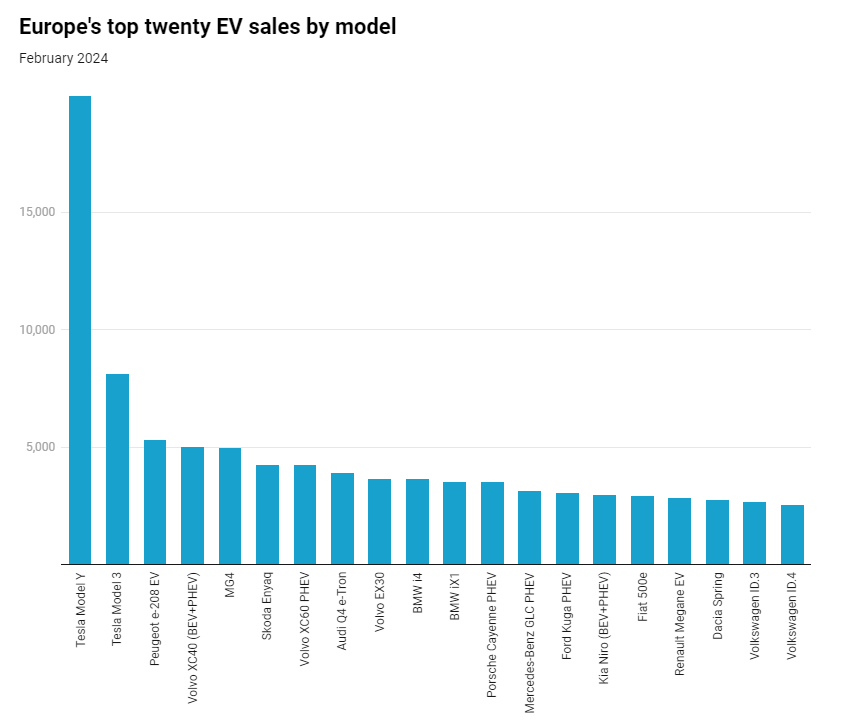
Once again, the Tesla Model Y was the best-selling EV in Europe, thanks to its 19,946 registrations in February. The mid-size crossover is expected to post similar results in the next few quarters, although it is not predicted to significantly improve on current volumes.

The Model Y’s biggest European market was Germany (5,482 units) followed at a distance by France (1,982 units). Also achieving four-digit demand was the UK (1,759 units), Norway (1,749 units), Belgium (1,737 units), and Italy (1,252 units).

EV
Chart: Autovista24 / Source: EV-Volumes.com / Created with Datawrapper

The Tesla Model 3 secured second, meaning the carmaker took the top two positions in the February best-sellers table. The sedan reached 8,120 deliveries, as demand was boosted by its recent refresh. It is expected to limit volumes for the Model Y in future months.

However, the Model 3 could be challenged for its runner-up position if the Volkswagen (VW) ID.4 recovers and the Renault 5 has a strong production ramp-up. The sedan saw strong performances in the UK (1,410 units), France (1,216 units) and Portugal (762 units).

Positives for Peugeot

Third place went to the Peugeot e-208, which posted its best registration tally since September 2023, with 5,319 models taking to the road. The hatchback has struggled in the last few months following its refresh. Yet, strong demand is now expected after the end of the e-208’s production constraints.

The model is making a big push in its domestic market, as France (4,132 units) was responsible for over 75% of deliveries. The Netherlands (326 units) and the Italy (173 units) followed far behind.

In fourth was the Volvo XC40, reaching 5,034 registrations. The BEV version accounted for the majority of this volume, with 4,808 units. The SUV is not yet being cannibalised by its younger sibling, the EX30.

The strongest market for the model was Germany (1,367 units), while Belgium (636 units) and Sweden (561 units) also had positive results.

The MG4 finished in fifth, thanks to 4,990 deliveries. Its main markets were Germany (1,503 units), France (1,491 units) and the UK (850 units).

Valiant Volvo

The Volvo XC60 PHEV came in seventh (4,251 units), becoming the best-selling plug-in hybrid model in February.

Its sibling, the Volvo EX30, made its first top 10 appearance, reaching ninth with a record 3,675 registrations. This meant three models from the Swedish brand featured in the top 10. The compact crossover is expected to continue climbing the best-sellers chart, with multiple top-five presences likely in the next two quarters.

Elsewhere, the BMW iX1 had a strong February in 11th place, posting 3,540 deliveries. Just behind, the Porsche Cayenne PHEV achieved its best-ever result, with 3,516 registrations placing it in 12th.

This performance was helped by a refresh that improved performance, including a bigger battery. The German SUV was February’s best-selling full-size model and was the second most popular PHEV.

Finally, the VW ID.3 (2,687 units) and ID.4 (2,538 units) returned to the table in February, in 19th and 20th place respectively.

Model Y magic

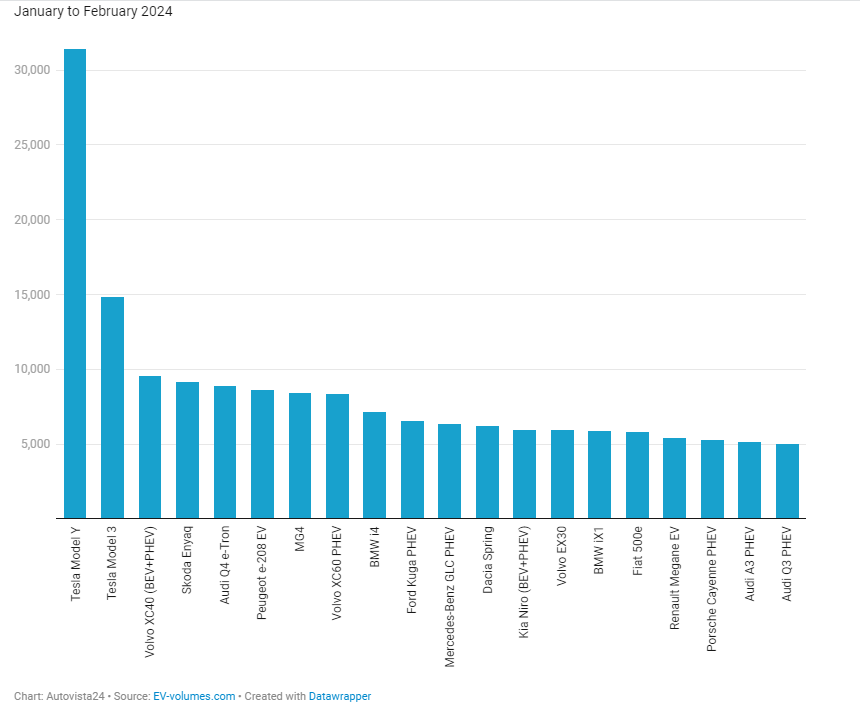
Looking at the year-to-date table, the Tesla Model Y maintained its lead, thanks to 31,410 deliveries. The crossover doubled the deliveries of the Model 3 in second (14,815 units).

Europe’s top twenty EV sales by model

European EV market
Below, the Volvo XC40 jumped two positions into third with 9,585 registrations. The SUV sits over 5,000 units behind the current runner-up and more than 400 deliveries ahead of the Skoda Enyaq in fourth place (9,124 units).
Thanks to a strong February, the Peugeot e-208 rose five positions to sixth with 8,594 registrations. The hatchback sits just one unit behind the Audi Q4 e-Tron and is predicted to continue climbing up the table over the next couple of months.
Meanwhile, the Mercedes-Benz GLC PHEV moved into 11th (6,342 units). In 14th, the Volvo EX30 (5,927 units) was a new entry to the year-to-date chart and is expected to join the top 10 soon. Another new model in the table was the BMW iX1 in 15th (5,897 units).

Elsewhere, the Renault Megane EV jumped up two positions to 17th (5,439 units). Below, the Porsche Cayenne PHEV joined the table in 18th (5,281 units).

Last year’s third-place finisher, the VW ID.4, was absent from the top 20 due to a slow start to 2024. March could see the crossover return to the table, along with its sibling, the ID.3.

Tesla on top

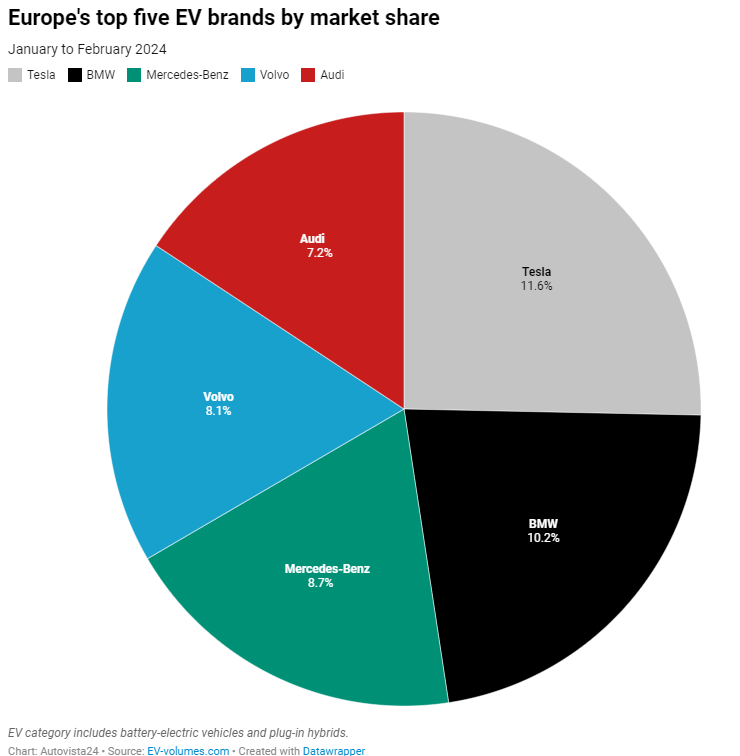
Tesla was comfortably Europe’s best-selling EV brand in February, accounting for 11.6% of all plug-in registrations, up 2.5 percentage points from January. BMW came second, with a 10.2% market share down marginally from the previous month.

Tesla

Mercedes-Benz maintained its third position (8.7%, down from 9%), but its lead over Volvo in fourth (8.1%, up from 7.8%) dropped.

Audi lost significant ground in fifth, dropping 1.1 percentage points to a 7.2% share. This meant all of the top five EV carmakers in February were premium brands. VW, the most popular mainstream manufacturer, finished in sixth (5.1%, up from 5%).

With brands grouped together under their parent companies, the VW Group kept its commanding lead but dropped one percentage point to a 19.5% market share.

In second, Stellantis accounted for 12.2% of all EV deliveries (up from 12%), while Tesla took 11.6% of the market. The US carmaker could challenge for the runner-up spot in March.

Meanwhile, the BMW Group dropped marginal share in fourth (10.9%), as fifth-placed Geely-Volvo continued its rise (9.9%, up from 9.6%). The OEM stretched its advantage over Mercedes-Benz Group in sixth (9.2%, down from 9.5%).

This content is brought to you by Autovista24.

Launch Report: Volvo EX30 presents premium B-SUV package

Autovista24

The Volvo EX30 is a premium entry to the B-SUV segment. Autovista Group (now part of J.D. Power) experts from Austria, France, Spain and the UK, analyse the model with Autovista24 special content editor Phil Curry.

Volvo has long led the charge for sustainable mobility, through both electric drives and the recycling of plastics. It brings this vision to life in the new EX30, a B-segment SUV with a battery-electric drive.

The model allows Volvo to expand into a new marketplace, meeting a growing demand for small electric SUVs. As a premium vehicle in the segment, it allows the carmaker to appeal to buyers looking to stand out from the crowd.

In Autovista24’s latest Launch Report, the EX30’s strengths, weaknesses, opportunities and threats are benchmarked against its key rivals. New price points are also outlined alongside forecast residual values.

A strong design

The Volvo EX30 is the brand’s smallest SUV. As a battery-electric vehicle (BEV), it enters a market that is becoming increasingly popular and even more congested with models.

So, standing out in the crowd is extremely important, and the Volvo EX30 achieves this. The smooth grille, a feature on BEVs due to the lack of large radiators, allows the brand’s badge to sit prominently.

On each corner, the ‘Thor’s Hammer’ style headlights sweep out and down the sides. This creates a recognisable lighting profile, making the model stand out both during the day and at night.

At 4.23 metres, this is the smallest-ever SUV Volvo has produced but its side profile belies this. The SUV’s tall side panels and doors are lined down toward the front end, providing a feeling of motion even when the vehicle is stationary.

Too minimalistic inside

Inside, the Volvo EX30 sports a minimalistic environment, with few switches and buttons. Instead, most of the auxiliary items are controlled using the 12.9-inch vertically-mounted touchscreen. This also includes the speedometer and driver information.

The EX30 does not have a dedicated driver cluster behind the steering wheel, and there is no heads-up display. This means the driver needs to glance downwards to get any information, and some of this data is buried in a multi-level menu system.

This raises some safety concerns which, for a brand as safety-conscious as Volvo, is a concern. These worries are also noted and addressed by the car itself, which activates audio alerts when it detects the driver’s eyes straying from the road ahead. This forms part of new safety systems designed to monitor driver behaviours.

The seating position is comfortable, and the front of the cabin provides plenty of room. The Geely SEA platform locates batteries beneath the floor, meaning there is no rear tunnel, allowing for more comfort. Yet the position of the front seats does impact legroom for taller passengers in the rear of the car.

Materials are not only of good quality but also contain recycled materials in-line with Volvo’s sustainable attitude. The carmaker states that 17% of the plastics inside the model are recycled, the highest percentage of any Volvo model to date.

Safety remains a priority

For its price point, the EX30 has a high power output, with the single-motor version producing 272hp and a 0-100kph time of 5.6 seconds. The model also offers a decent range, with the entry-level version capable of reaching 340km on a single charge. It provides a comfortable drive, although the twin-motor variant is heavier, which increases the body roll when cornering.

Aside from the issues surrounding the vertical touchscreen display, the EX30 builds on Volvo’s reputation as a brand that cares about safety. Most common assistance systems, such as adaptive cruise control and lane-departure warnings are available as standard across all trim levels. Meanwhile, the driver monitoring system is helpful if attention is diverted away from the road, for reasons other than adjusting the wing mirrors.

Overall, the Volvo EX30 is a strong entry into the B-SUV segment, one which will appeal to premium buyers looking for a smaller BEV to get around. Some of its flaws are fixable via over-the-air updates, and as the carmaker ramps up production, it is likely to take over as the brand’s most popular model.

View the Autovista Group dashboard, which benchmarks the Volvo EX30 in Austria, France, Spain, and the UK. The interactive dashboard presents new prices, forecast residual values, and SWOT (strengths, weaknesses, opportunities, and threats) analysis.

This content is brought to you by Autovista24.
BYD took control of the 2023 Chinese EV market

Electric vehicles (EVs) made up 37% of China’s new-car market in 2023, with BYD and Tesla leading the way. José Pontes, data director at EV-volumes.com, unpacks the results.

The electrification of China’s new-car market has picked up in recent years. Combined registrations of battery-electric vehicles (BEVs) and plug-in hybrids (PHEVs), meant the EV market represented 6.3% of deliveries at the end of 2020. BEVs alone accounted for 5.1% of the overall figures.

In 2021 this market share grew to 15% for EVs overall and 12% for BEVs specifically. Across 2022, plug-in models accounted for 30% of deliveries in the country, with all-electric vehicles taking a 22% share. By the end of 2023, the EV share had climbed to 37%, with BEVs generating 25% of overall registrations.

So, while electrification in China has improved, the rate of adoption has slowed over the course of the last three years. However, the world’s largest automotive market can still be expected to reach an EV share of 50% by 2026. By this point, BEVs will make up over a third of the new-car market.

BYD Song tops the chart

The BYD Song was the best-selling EV in China last year, repeating its 2022 success. The model finished 2023 more than 100,000 units ahead of the second-place Tesla Model Y. The US crossover surpassed the BYD Qin Plus at the very end of last year.

However, BYD placed five models within the top six positions of the 2023 chart, while also leading every size category.

The BYD Seagull managed to overtake the Wuling Mini EV in the A-segment. The carmaker’s Dolphin model led the B-segment and its Yuan Plus claimed the C-segment. Lastly, the Song secured the D-segment, and the Han took the E-segment. BYD can be expected to top a lot of categories again this year, however, it will face more competition.

The Li Auto L7 and Aito M7 will likely overtake the BYD Han in the E-segment. In the D-segment, the Tesla Model Y will look to state its claim to the title, as BYD’s models compete against each other in the popular category.

This story is likely to be repeated in the C-segment, with the GAC Aion Y competing with the BYD Yuan (Plus and Up). In the B-segment, the Wuling Bingo could become a fiercer contender for the title.

Comparing the 2023 table with the previous year, the Wuling Mini EV dropped five places to seventh due to increasing competition. The ageing BYD Tang also dropped from eighth in 2022 to 13th.

Noticeably, several small EVs were pushed out of the table this year, such as the Changan Benni EV, the Chery eQ1, and QQ Ice Cream. While Changan could rely on the 14th-place Lumin, Chery lost its two spots without any replacements.

Third title for BYD brand

BYD claimed its third brand title in a row last year, with a 33.8% market share. Since it started making plug-in models in 2008, the carmaker has always made it to one of the two top spots in China’s brand table. This highlights its importance to the electrification of the market.

Meanwhile, Tesla took second place in 2023 with a 7.5% share. This marks a step up for the company following three years of third-place finishes.

Thanks to the success of its Aion S and Y models, GAC Aion secured a top-three spot for the first time last year, coming in third with a 6% market share. This is a positive result for the brand after coming fourth in 2022 thanks to a 4.6% share.

Despite the success of its Wuling Bingo, SGMW experienced a significant loss of volume in 2023, as the Wuling Mini EV dropped by about 200,000 units. The brand ended the year with a 5.8% share, contrasting with the 8% it had in 2022.

Li Auto came fifth with a 4.7% share, replacing Changan with 4.3%. However, the latter still managed to finish in sixth while increasing its market share from 3% in 2022. Geely once again took seventh, but made up 4.1% of the market, up from 3.7% at the end of 2022.

Demand set to drop?

With brands organised under automotive groups, BYD was once again the big winner in China with a market share of 35.5% in 2023. Having taken last year’s title, this is likely to be a repeating trend in the coming years.

However, having also claimed first place in the wider overall market, the OEM is starting to near its demand ceiling, leaving little room for growth in China.

In second, SAIC claimed a 7.5% share. The carmaker claimed this spot in the last month of 2023, managing to push ahead of Tesla by just 518 units. In fourth, Geely–Volvo appears set to keep growing. The company ended 2023 with a market share of 7.1%, a significant increase on 5.7% in 2022.

GAC secured fifth, progressing from a 4.9% share in 2022 to 6.5% last year. Changan climbed up a position from 2022, as its market share grew from 4% to 4.8% last year.

Record end to a record year

EVs finished 2023 with another record month. Registrations of plug-in models grew 46% year on year, reaching a record 980,737 units. BEVs (up 31%) saw slower growth than PHEVs in the month (up 81%).

Yet all-electric models accounted for 63% of the EV market in December, but this was below 2023’s BEV 66% average. This was far below the 74% recorded at the end of 2022.

The up-swing in PHEV popularity can be explained by the increasing availability of range-extended models in China. Most of these models feature a battery with around a 40kWh capacity and fast-charging capabilities.

BYD Song dominates in December

The BYD Song continued its run of record-breaking success in December. Out of its 72,182 total deliveries, its BEV version reached a new best of 14,011 units. This highlights how production is leaning further towards the all-electric powertrain.

This could mark the current generation’s peak. The Song was the best-selling model in December’s overall new-car market in China, but there will be increasing competition moving forward. A large portion of this will come from inside BYD, in the shape of the new Song L and the Sea Lion.

In second place, the Tesla Model Y achieved 60,055 registrations in December, a new record. This is impressive considering the increasing amount of competition in the market, including internally from the refreshed Model 3.

As the standard BYD Song gets cannibalised by its siblings, Tesla Model Y can be expected to regularly feature in first this year, even if its sales do not grow significantly.

The BYD Qin Plus ended December in third with 41,142 deliveries. The midsize model is likely to keep competing for a place in the top five throughout 2024, at least until the new Qin L arrives sometime in the near future.

Thanks to constant updates, the Qin Plus is leading the midsize-sedan category, well ahead of the GAC Aion S and the Tesla Model 3.

With 41,012 registrations, the BYD Seagull came fourth. However, this was not a new best for the model, ending a record-breaking streak and suggesting a slowing of deliveries. With exports expected to start soon, the city-car could see greater success in overseas markets where demand for small and affordable BEVs is high.

The BYD Yuan Plus came fifth in December with 30,799 registrations. While the model did well across 2023, a top-five finish might be difficult to replicate this year. Some of its volume will likely be consumed by the cheaper Yuan Up, due to land in the first half of 2024. However, export markets are now the target for the Yuan Plus, especially in Europe and Southeast Asia.

Li Auto’s record results

Having created a niche within the Chinese market, the Wuling Bingo came sixth in December and could enter the top five soon. The eighth-place Aito M7 (25,545 units) also deserves a mention, with the model continuing to accelerate production.

Highlighting a positive month for Wuling HongGuang, its Mini EV ended the month in ninth with 25,015 registrations, a year best.

All three of Li Auto’s models saw record numbers in December. In 11th, the L7 recorded 20,428 registrations, while the L8 marked 15,013 units. Just below, the flagship L9 posted 14,913 deliveries. This means the carmaker hit over 50,000 units in the month while only being present in the full-size segment.

Elsewhere, the Volkswagen (VW) ID.3 kept rising, reaching a best-ever 13,201 sales. This allowed it to reach 17th place.

Outside the top 20

The refreshed Buick Velite 6, a compact estate car, scored a record 8,614 deliveries in December. Meanwhile, the VW ID.4 registered a year-best result of 8,130 units. Add this to the ID.3’s record performance and the German carmaker seems to be enjoying some success in its largest market.

Geely celebrated the Lynk & Co 08 crossing the 10,000-unit delivery mark for the first time. The model passed this milestone after only four months on the market.

Changan posted good results across its line-up. This included 12,480 registrations for the Lumin and 6,978 units of the SL03. However, the highlight was the S7, which recorded 11,360 deliveries. This included 3,250 BEV registrations, a new record for the model.

BYD hailed the first full sales month of its new upmarket brands, Fangchengbao and Yangwang. Their respective first models, the Bao 5 and the U8, hit 4,388 and 1,593 units each. These new brands can be expected to improve the OEM’s profit margins, which could act as a reserve in the country’s price wars.

While SAIC enjoyed good results with the Wuling Bingo and the Mini EV, the brand’s new model, the Starlight, was a particular cause for celebration. The model reached 11,453 units in December, its third month on the market.

Elsewhere in the SAIC stable, the Roewe D7 was also on the rise, taking 7,285 registrations. Meanwhile, the IM LS6 SUV hit 9,878 deliveries in only its fourth month on the market. However, it seems the model’s demand ceiling has already been hit.

What was the most popular EV worldwide in 2023?

The global electric vehicle (EV) market broke records throughout 2023. Leading this charge was the Tesla Model Y. José Pontes, data director at EV-volumes.com, unpacks the year and its most popular performers.

New EVs, consisting of battery-electric vehicles (BEVs) and plug-in hybrids (PHEVs), saw global registrations jump 35% year on year in 2023. This allowed the electric market to end above the 13 million mark for the first time.

Plug-in models made up a record 22% of the entire new-car market in December, with BEVs accounting for 15% alone. This pushed 2023’s total EV share to 16%, a small rise from 14% in 2022. BEVs made up 11% of registrations worldwide last year, up from 10% in the previous year. It is worth considering that the overall global new-car market experienced double-digit growth in 2023.

PHEVs (up 47%) saw registrations grow more quickly across 2023 than BEVs (up 30%). This meant the hybrid powertrain increased its share of the EV market, reaching 31%, up from 28% in 2022. The PHEV share has been fluctuating between 26% and 31% since 2018, supporting the notion that the technology could remain relevant for a while.

Best-selling car in 2023

The Tesla Model Y recorded 1,211,601 registrations across 2023. This made it the best-selling model in both the new EV and the overall new-car market. The BEV saw deliveries grow 57% year on year, up from 771,000 units in 2022. The crossover can be expected to stay a market leader in 2024.

The BYD Song secured second place, as the Chinese SUV ended the year with 636,533 registrations, up 33% on 2022. Meanwhile, the Tesla Model 3 hit a new record of 529,287 registrations, putting it in third.

But despite its recent refresh, the Model 3 has reached full maturity. The sedan has seen its market share erode from 14% in 2019 to 12% in 2020, then 8% in 2021, 4.7% in 2022 and 3.9% last year. Sales have struggled to maintain momentum since hitting over 500,000 units in 2021.

Compared with 2019, last year’s result represents growth of 6% for the Model 3. But in the same period, the EV market more than doubled from 6.6 million units to nearly 13.7 million units, illustrating the BEV’s market limits.

BYD’s block

Below the top three, there was a block of BYD models. This included the Qin Plus in fourth, the Yuan Plus/Atto 3 in fifth, and the Dolphin in sixth. The BYD Seagull ended the year in seventh, profiting from a great performance in December and jumping two places. This meant the top seven places were dominated by just two carmakers.

The BYD Han won another full-size category title, followed by its sibling, the Tang. But both models saw declining sales in 2023, by 17% for the Han and 7% for the Tang. It will likely be much harder for the Chinese brand to retain the full-size category title in 2024.

In the second half of the table, the Volkswagen (VW) ID.3 was up one position to 15th. Last year was a great one for the hatchback, as its sales jumped 79% year on year to 139,268 units. Thanks primarily to its success in China, this is the first time the BEV crossed the 100,000 mark.

GAC Aion also had a good year with its Y and S BEVs, with sales almost doubling. This put the models in ninth and 11th respectively. But Li Auto made even greater strides, as the startup placed all three of its full-sized EVs in the top 20.

Four models from legacy OEMs made it to the top 20 in 2022, namely the VW ID.4, the Hyundai Ioniq 5, the Ford Mustang Mach-E, and the Kia EV6. But this count fell to just two in 2023, with the VW ID.4 in 12th and ID.3 in 15th. Considering the Audi Q4 e-Tron finished in 21st, the top three models from a legacy OEM all belonged to VW Group.

Success by segment

Chinese models took the EV A-segment by storm in 2023. Coming seventh in the overall EV ranking, the BYD Seagull took the category title from the eighth-place Wuling Mini EV. The Seagull is a top contender to repeat its success in 2024. The Changan Lumin came third in the category, far from the top two.

The B-segment also saw many Chinese models succeed. The category was led by the BYD Dolphin which came sixth overall, followed by the Wuling Bingo in 13th. The Peugeot e-208 came next but at a great distance from the top two with some 51,000 registrations. This was more than 100,000 units below the Bingo and some 300,000 units behind the Dolphin.

The C-segment was led by the BYD Yuan Plus/Atto 3. The crossover ended 2023 at 418,994 units, double its 2022 result. The GAC Aion Y came next with 235,861 deliveries, followed by the VW ID.4 with 192,686 registrations. Expect an exciting competition between the top two this year. However, the BYD Yuan Up, a smaller and cheaper sibling of the Yuan Plus, could provide a surprise.

Tesla’s D-segment

Tesla ruled over the D-segment in 2023. The Model Y was the clear leader, while the Model 3 came third. Between the two was the BYD Song. However, the Model Y already looks set to secure the category win again in 2024.

Three Chinese models commanded the E and F-segments. The BYD Han recorded 228,007 registrations, the BYD Tang 141,581 registrations, and the Li Auto L7 134,089 registrations. Should Li Auto or Aito want to compete for a top spot this year, a minimum production capacity of 150,000 units a year will be the bare minimum. Even so, the category leader will likely end up past the 300,000-unit mark.

Pickup trucks saw a second year of relevance in 2023 with around 52,000 deliveries, up 44% year on year. The Ford F-150 Lightening posted roughly 25,000 deliveries while the Rivian R1T managed some 15,000. Geely’s Radar RD6 took third with 4,736 units. In 2024, the Tesla Cybertruck is likely to disrupt this trio.

A total of 9,511 fuel-cell electric vehicles were registered in 2023, down 38% on 2022. This followed a drop from 2021, the year FCEVs reached a peak of 15,434 registrations. In 2023, the Hyundai Nexo (5,000 units) beat the Toyota Mirai (4,000 units).

Best-selling brands in 2023

In terms of brand volumes, BYD beat Tesla by a significant margin in 2023. With a 56% year-on-year growth rate, the Chinese company was the fastest-growing marque in the top three, allowing it to increase its lead to over one million units.

However, this trend is unlikely to continue into 2024. BYD is running out of room to grow in its domestic market, meaning the demand ceiling is closing in. Yet this supports the company’s overseas strategies, plans which could come to define the EV market in 2024.

In 2023, the Chinese brand started to export its EVs in significant volumes. Israel saw 15,000 units, Brazil 18,000 units, and Thailand 30,000 units.

In second place, Tesla’s market share continued to suffer erosion. This sat at 17% in 2019, 16% in 2020, 14% in 2021, and then 13% in 2022 and 2023. This could potentially stabilise around 10% in the future. The US carmaker will need to diversify its line-up if it wants to retake the brand title.

Due to a slow first half of the year, SGMW ended in sixth allowing BMW to take third. It may be difficult for the German carmaker to hold on to this position in 2024, considering the pack of fast-growing Chinese brands behind it.

In fourth, GAC Aion grew 78% to some 484,000 units, however, this growth will be difficult to sustain. So far, the brand has not found a way to replicate the success of its S and Y models.

This puts the carmaker in the sights of the rapidly-growing Li Auto in seventh. Its three current models will reach maturity in 2024. Then there are the upcoming launches of the Mega and the L6, which could mean the brand will deliver up to 700,000 units next year.

Benefitting from a slow December for Toyota, Nio was also able to climb up the ranking in the last month of 2023. The carmaker ended the year in 16th, a five-position jump from its previous year’s standing. However, it could be difficult for the startup to remain in this spot given a lack of new models for 2024 and a sluggish export performance.

The other two brands to benefit from Toyota’s downfall were Ford, climbing one position to 17th, and Jeep, up to 18th. Out of all the legacy marques on the table, Jeep was the fastest growing, having seen its sales jump 53% compared to 2022. It ended the year as Stellantis’ best-selling brand, 23,000 units ahead of Peugeot in 22nd.

Outstanding OEMs in 2023

Gathering EV sales by automotive group, BYD claimed a 22% market share, with 3,012,070 registrations. Tesla came second with an 13.2% share and 1,808,652 deliveries. This puts the two OEMs in a league of their own, controlling over a third of the market together.

VW Group remained in third, with a 7.3% market share, making it the leading legacy OEM. Meanwhile, Geely–Volvo (6.8% share) took fourth from SAIC (5.8% share) towards the end of the year. This means the fight for third in 2024 will be one to watch.

Stellantis (4.2% share) stayed in sixth but has lost half a percentage point compared to the end of 2022. However, the OEM delivered nearly 600,000 units last year. This means it should reach the one-million-unit scale for EV profitability by 2025, or possibly 2026.

BMW Group (4.1%) rose to seventh place and the German OEM should be competing for sixth throughout 2024. Hyundai Motor Group (3.7% share) dropped from seventh in 2022 to ninth in 2023, losing almost a full percentage point from 4.6%. The Korean OEM was also surpassed by GAC, which ended the year with a 3.8% share.

Battle of the BEVs

Looking only at BEVs, Tesla took the 2023 OEM title with 19.1% of the global market. This was up from 18.2% in 2022 but was down from the 23% it commanded at the end of 2020. Second went to BYD with a 16.5% share of the BEV market.

While Tesla’s market is likely to erode slightly in 2024, BYD will keep gaining share. This will be thanks to a larger number of BEVs in BYD’s line-up, including the Yuan Up and Sea Lion. Additionally, exports will be more focused on BEVs, with PHEVs only being used in select markets.

VW Group took third with an 8% share, while SAIC took fourth with a 7.9% holding. In fifth, Geely–Volvo claimed 6.2% of the market. Sixth-place GAC was a sizable distance behind, with a 5.3% share. Nevertheless, the OEM had a positive 2023, up from 4% in 2022.

BYD nears local limit

There are a number of trends already emerging which provide a good insight into what the automotive market can expect from the EV segment in 2024 and beyond.

The BYD brand is already close to its demand ceiling in China, meaning the OEM is increasingly focused on its premium brands. This includes Yangwang, Fangchengbao and Denza.

With a higher average price, margins are expected to improve. This will give BYD more options when pricing its mainstream models. But with competition heating up in the Chinese EV market, BYD will need to keep its line-up fresh to hold on to its share, while also considering pricing.

As such, growth will have to come from overseas markets which is something BYD has been preparing for. As well as buying and chartering its own vehicle vessel, it is building factories in places such as Thailand, Indonesia, Brazil, and Hungary.

Tesla’s production planning

Tesla delivered 1,808,652 units in 2023, but with little in the way of new offerings, the carmaker is unlikely to see rapid growth in 2024.

Tesla’s current issue is its lack of product planning. The Model S is now 12 years old, making a second generation rather overdue. The Model X is in its ninth year, meaning a new version should have been presented by now.

Meanwhile, the Model Y (2020) has reached maturity as has the Model 3, which launched in 2017 and only saw a refresh in 2023. Their successors should, therefore, be on the drawing board. However, this does not appear to be the case. The carmaker would do well to consider how it manages the lifecycles of its products.

VW Group and Geely

While suffering some management changes in recent years, VW Group is still the best-performing legacy OEM by far. With close to one million EV deliveries in 2023, its long-term survival is well assured.

Moving into 2024, the OEM’s leading models will mature. The only new models will be the VW ID.7, the Cupra Tavascan, the Skoda Elroq, the Porsche Macan, and the Audi Q6/A6 e-Tron.

Meanwhile, Geely has been steadily gaining ground in the EV OEM ranking in the last few years, ending 2023 in fourth with 925,111 registrations. This was only some 69,000 units below VW Group.

SAIC the export expert

While SAIC excels at exporting, it could do better locally. The OEM aims to sell around 1.4 million vehicles abroad this year. However, this does include models powered by internal-combustion engines.

With 14 new EVs expected by 2026, SAIC hopes to replicate the MG4’s success with other launches. This includes venturing into the premium end of export markets with its new IM brand. Therefore, 2024 is likely to see a new MG5 station wagon, a ZS crossover, and a flagship SUV model.

Another monthly title for Tesla

The Tesla Model Y took another best-seller position in December, with 128,410 deliveries. The crossover can be expected to keep racking up monthly titles this year as it has reached full maturity. With a refreshed version coming around April, it is likely to be the best year of the current generation.

In second place, the BYD Song hit a record 76,086 registrations. This could be its peak, with the recently-arrived Song L ready to cannibalise a significant volume of its sales in 2024, as will the upcoming Sea Lion.

Third place in December went to the Tesla Model 3, which posted more than 56,896 deliveries, ending well ahead of the BYD Qin Plus in fourth (44,701 units). Further down the ranking the Wuling Bingo came eighth (27,458 units), thanks to its continuous production ramp-up. The small EV seems ready to compete with BYD’s leading models for a top spot in 2024. 

The VW ID.3 finished the month in 15th. The model recorded 17,861 registrations globally in December, its best score since the end of 2020 when VW delivered units to dealerships to comply with emission requirements.

Thanks to price cuts in China, the ID.3 saw its fortunes change completely in the market. This helped compensate for its milder performance in Europe. Elsewhere in the compact category, SAIC’s MG4 (Mulan in China) scored 12,964 registrations in December, its second record score in a row.

Made in China

Some of December’s most significant figures were recorded in the full-size category. The entire Li Auto line-up reached record heights. The L7 marked 20,428 registrations, the L8 saw 15,013 deliveries, while the L9 marked 14,913 units.

December’s best-selling full-size model was the Aito M7, which took ninth place in the EV market with 25,545 deliveries. With Huawei putting its weight behind the brand, sales increasing rapidly.

Every model in December’s top 20 was made in China. A total of 16 belonged to Chinese carmakers, with seven coming from BYD alone. This illustrates the importance of the Chinese market in the broader EV industry.

Successful SUVs

Outside of December’s top 20, the Geely Panda Mini was close to joining the table, having ended the month fewer than 300 units behind the BYD Tang in 20th. The compact Audi Q4 e-Tron was also close, with 11,260 registrations.

In the midsize category, SUVs were trending with several record-breakers. After several years on the market, the Volvo XC60 PHEV hit a best-ever global total of 7,868 registrations. Deliveries of the Lynk & Co 08 PHEV reached 10,055 units, while SAIC’s IM LS6 posted 9,878 units, and the Changan’s Deepal S7 11,360 units.

However, the recent Wuling Starlight from SGMW proved that success is not restricted to SUVs, recording 8,050 deliveries in December. In the full-size category, the Jeep Grand Cherokee PHEV reached a record 7,299 registrations.

The BMW i4 achieved another registration record, with 11,203 units delivered in December. This made it the best-selling EV produced outside of China. However, the i4 only posted a fifth of the registrations achieved by its competitor, the Tesla Model 3.

The BMW iX1 also achieved a new best of 8,775 deliveries, its third record in a row. Meanwhile, the iX also shined, with 7,027 registrations.

A record month for brands

BYD managed another record month in December, this time with 320,928 registrations. It once again beat Tesla, which posted 195,265 deliveries.

SGMW came third thanks to a best-ever monthly tally of 69,912 registrations. Its three models (the Mini EV, Bingo, and Starlight) contributed decisively to this performance. In fourth with 59,480 deliveries, BMW had a record month thanks largely to the success of its i4 fastback (11,203 registrations), but also the iX1 (8,775 units) and iX (7,027 units).

VW came fifth with 52,042 registrations, followed closely by Li Auto with a new best of 50,356 units. In the same month last year, it posted 21,233 registrations. In eighth, Changan recorded 43,095 deliveries, its second-best performance in a row, thanks to the Lumin and Deepal S7.

MG4 boosts SAIC

SAIC made it to 11th with a record 35,334 registrations. This was owing to the performance of its star player, the MG4. Aito rocketed up to 12th with its M7 SUV and even larger M9. The brand hit a record 30,108 units in December.

In 13th, Audi also registered its best month with 28,024 deliveries in December, thanks to the Q4 e-Tron. XPeng came 17th, with 7,673 registrations of its G6 midsize SUV in December. This allowed the carmaker to hit a total of 20,105 units in the month, almost catching Hyundai in 16th (20,631 units). Chery came 20th thanks to the positive results of the QQ Ice Cream (7,462 units).

Jeep landed in 21st, making it the best-selling US legacy brand as well as Stellantis’ best-selling marque. With 17,723 registrations, it achieved a new record. This was down to the continued success of the Wrangler PHEV and Grand Cherokee PHEV.

Lynk & Co came 22nd with a new best of 17,505 deliveries. The 08 SUV accounted for the bulk of the registrations (10,055 units), allowing the Chinese brand to end close to the table.

Which manufacturer supplied the largest volume of EV batteries in 2023?

Battery suppliers are a crucial part of the electric vehicle (EV) industry. But which company manufactured the greatest volume of EV batteries in 2023? Autovista24 editor Tom Geggus and special content editor Phil Curry explore the numbers.

According to the latest data from EV-volumes.com, global production of EV batteries grew 42% year on year in 2023. This equated to a total output of over 680 gigawatt-hours (GWh) worth of cells made for passenger cars and vans.

Battery suppliers measure their output in GWh rather than the total number of units produced. One GWh is equivalent to one million kilowatt-hours (kWh), the measurement often found in battery-electric vehicle (BEV) specifications. If an average BEV has a capacity of 50kWh, then 1GWh worth of batteries could supply some 20,000 models.

Autovista24 · Which manufacturer supplied the largest volume of EV batteries in 2023?

Subscribe to the Autovista24 podcast and listen to previous episodes on Apple, Spotify, Google and Amazon Music.

Show notes

Autovista24: Who makes the most electric vehicle batteries?

Autovista24: CATL drove global EV battery production in first three quarters of 2023

CATL: CATL and JAC reach strategic cooperation to promote e-mobility

CATL: CATL and MHERO signs strategic cooperation agreement on “CATL Inside”

BYD: BYD to build a new energy passenger vehicle factory in Hungary for localised production in Europe

LG: LG Energy Solution to invest in promising US lithium metal battery technology startup, solidifying leadership in next-generation battery technology

CATL far out in front

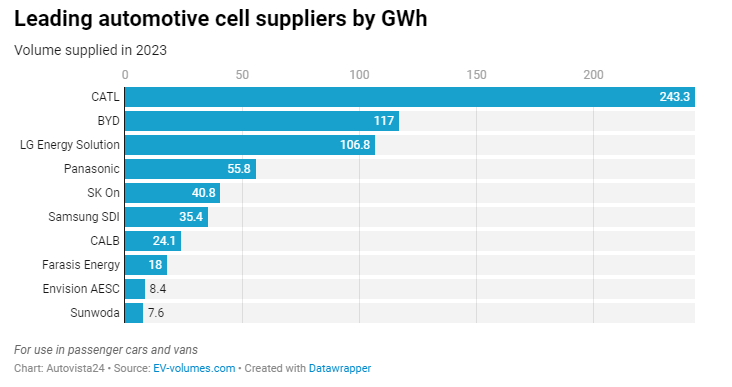
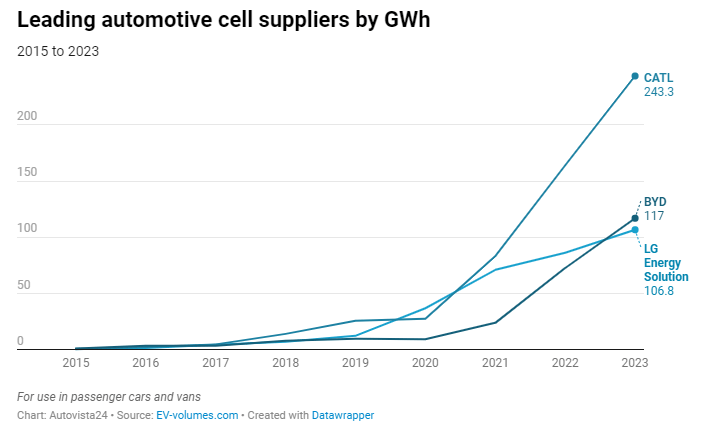
The clear front-runner in EV battery production during 2023 was CATL, with a cell output of 243.3GWh, up 48% compared with 2022. The company claimed 36% of the market across the year.

EV battery

Chairman and general manager of CATL, Robin Zeng, spoke at the World Economic Forum in Davos at the beginning of 2024. He said that battery innovation is central to transitioning the world towards a clean-energy future.

Zeng outlined how scaling wider battery production will benefit the automotive industry. ‘We are focused on the aviation applications for condensed batteries, and as production scales up, we can reduce the cost and use the battery in cars, too,’ he explained.

The manufacturer also recently confirmed two new strategic collaborations. Jianghuai Automobile Group (JAC) and CATL will cooperate in the supply of EV cells, the introduction of battery-swapping technology, and the joint development of new products.

Meanwhile, the battery maker will also work with MHERO, a subsidiary of Dongfeng Motor Corporation, as part of a three-year cooperation agreement. This will see CATL function as the primary EV-battery partner for the carmaker.

European BEV production

In second place, BYD increased its battery production by 61% year on year, with a cell volume of 117GWh. This meant the manufacturer claimed 17% of the market in 2023.

At the end of the year, the company confirmed it would open a new passenger car factory in Hungary, its first facility in Europe. BYD was keen to point out its vertical supply chain integration, which it claims will help create a local green ecosystem.

While localised vehicle assembly will help keep shipping emissions down, the company has yet to confirm whether batteries will also be made locally.

EV battery supplier

In third, with a volume of 106.8GWh of cell production, was LG Energy Solution. This marked a 16% increase from its 2022 output. In total, the manufacturer claimed 16% of the EV-battery market in 2023.

The company confirmed in late January that it had invested in Sion Power, a startup holding patents in lithium-metal battery technology. A lithium-metal anode can enable greater energy efficiency compared to existing lithium-ion batteries.

A close race

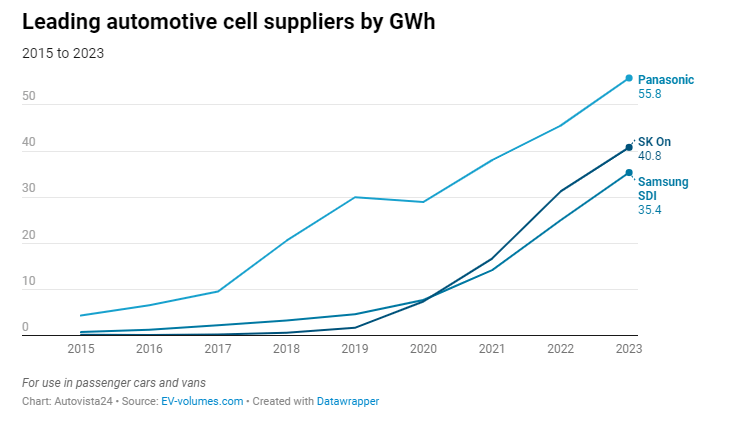
Towards the middle of the table, Panasonic claimed an 8% market share with a cell production volume of 55.8GWh. This was made for growth of 23% compared with 2022.

automotive cell

Next, SK On manufactured 40.8GWh worth of EV battery cells in 2023. This equated to an increase of 31% and a share of 6%. Next, Samsung SDI claimed 5% of the market, with a volume of 35.4GWh, up 41% year on year.

Huge growth

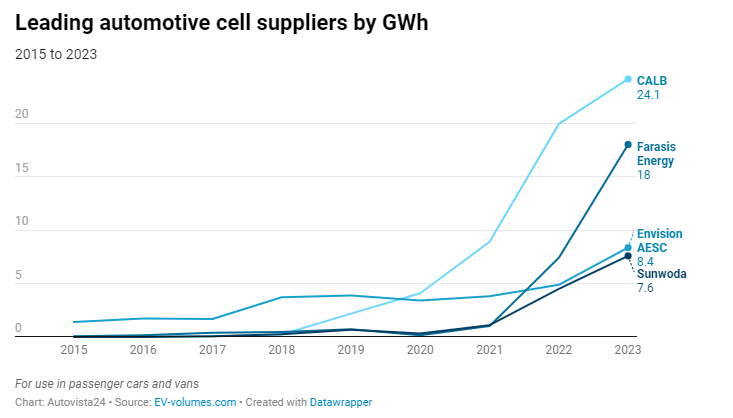
In seventh, CALB produced 24.1GWh worth of batteries, an increase of 21% on 2022. This output allowed the manufacturer to take 4% of the market. Farasis Energy achieved one of the largest rates of growth, up 143% year on year, with a volume of 18GWh and a market share of 3%.

EV cell
Envision AESC was responsible for 1% of production, supplying 8.4GWh of batteries, up 71% on 2022. Finally, Sunwoda produced 7.6GWh worth of EV cells, making for growth of 69% and a market share of 1%.
The unspecified manufacturer category accounted for 3% of the market in 2023, equating to roughly 23.6GWh worth of cells, a total that is up by 38% year on year.

This content is brought to you by Autovista24.
Autovista24

The green transition of electric trucks and buses

As electric vehicles (EVs) begin to make serious inroads into the passenger-car market, a green transition is also underway for heavy-duty trucks and buses. Przemek Kolasa, data manager for commercial vehicles at EV-volumes.com, examines the progress.

As a large contributor to global greenhouse gas levels, the commercial-vehicle sector is looking towards zero-emission possibilities. The development of battery-electric trucks and buses will lead to significantly cleaner mobility within logistics and passenger transport.

China leads heavy-duty electric-truck market

Currently, OEMs from China lead the way when it comes to the green transition of heavy-duty trucks, with a dominant share of the global market. However, the country has lost some of this share since 2021 as other markets have grown, with domestic OEMs building up their fleets.

In 2021, Chinese OEMs held a 96% share of the global market, while other countries only took a combined share of 4%. The slow shift to a more generalised market began in 2022, with China’s share dropping to 92%. Between January and September 2023, the country held 89%, with the other 11% shared between other regions.

Therefore, Chinese OEMs have seen their market share fall by seven percentage points in two years. This is the result of the green transition picking up in regions such as Europe and the US. As the number of Chinese OEMs in these markets is still relatively small, domestic manufacturers have not been impacted, allowing them to take advantage of their already well-established presence to appeal to regional customers.

Europe’s household names

Figures from the third quarter of 2023 show Volkswagen (VW) Group’s Traton division, led the European electric-truck market with a 37% share. It was followed by AB Volvo (29%) and Daimler Trucks (17%). Together, these three companies accounted for 83% of registrations, with the final 17% made up of all other manufacturers.

From January to September, Traton division, AB Volvo and Daimler Trucks significantly increased their registrations, growing 231%, 342% and 541% respectively year on year. Therefore, while the electric-truck segment is expanding rapidly in Europe, it is doing so without the need for Chinese manufacturers.

A more diverse electric-bus sector

The bus sector’s green transition started much earlier than that of trucks, meaning the market is more developed and diverse.

China does still lead the way, but its share dropped further than in the truck market. While in 2021 the country held a 95% market share, this fell to 90% in 2022. From January to September, the country held 81%. Other markets have eaten into the Chinese advantage, moving from a 5% holding in 2021 to a 19% share in the first three quarters of 2023.

A serious alternative

Unlike the electric-truck market, Chinese penetration in other countries has occurred. Focusing on Europe, domestic manufacturers are starting to offer a serious alternative to established China-based businesses, while the market is more spread out due to the development of green technology in the sector.

In the third quarter of 2023, BYD held a 12% share. However, VW Group, through its Traton division, closed rapidly, ending the period with 11% of the market. Close behind was CAF, which had a 9% market share across the three months.

However, the Traton division has experienced stunning growth in the electric-bus market over the first three quarters of 2023. The company increased its registrations by 242% in the nine-month period, while BYD only improved deliveries by 33%. CAF was also able to close in on BYD, with a 55% registration increase, but far from Traton’s impressive figures.

More to come

There is still a long way to go in the green transition of trucks and buses, as more manufacturers bring their products to market, and further technological developments play a part.

Markets are still in the early stages of a zero-emission push. This means that trends are very much dependent on a number of factors, such as battery development, hydrogen fuel cells for long distances, the market economy, and incentive packages.

All of these elements will play a crucial role in electric-truck and electric-bus uptake, helping propel the green transition of these vehicles further.